College of Health Sciencess
ABOUT ORSP SERVICES PROJECT PLANNING TOOLS & FORMS POLICIES/PROCEDURS RESOURCES
CHS MAIN PAGE
About the Graduate School


Mission and Goals

Our Mission

The Department of Physician Assistant Studies combines Marquette's Jesuit tradition of cura personalis ("care for the whole person") with the College of Health Sciences' Jesuit ideals of concern for the spiritual, emotional and physical development of the individual.

We're dedicated to educating physician assistants for supervised practice of primary medicine in dynamic health care systems. We realize our mission through a synergistic strategy of educational goals.

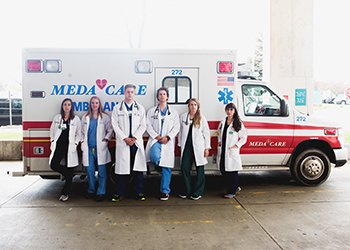
 

Educational Goals

We prepare each student intellectually, socially, affectively and spiritually to:

  • Thoroughly interview and examine patients, order appropriate tests, assess findings, and collaborate with the supervising physician and, whenever possible, the patient to determine the appropriate treatment plan.
  • Be effective communicators, listeners, observers and diagnosticians.
  • Instill the importance of counseling, educating and motivating patients and their significant others to take responsibility for their physical, mental and spiritual health.
  • Foster optimal PA and supervising physician relationships.
  • Identify true emergencies and respond appropriately.
  • Be responsive and committed members of the health care team and adhere to the team concept of health care delivery.
  • Develop a commitment to lifelong learning.
  • Demonstrate allegiance to the profession through participation in professional organizations.
  • Contribute to the education of future PA students by participating in physician assistant training.

Learning Outcomes

Graduates of the Physician Assistant program will be able to:

  • Perform an appropriate history and physical exam on individuals that concludes with a working diagnosis and initial treatment plan.

  • Apply the evidence-based principles of medicine to accurately diagnose and manage acute and chronic disease states and/or medical emergencies.

  • Function effectively as a member of the healthcare team in respect to interpersonal relations, team skills and written and oral communications.

  • Demonstrate a commitment to life-long learning by participation in professional development activities on a continuing basis.

  • Demonstrate cultural understanding and sensitivity in interactions with patients of diverse socioeconomic, ethnic, and alternative backgrounds.

  • Synthesize the medical literature on a given topic and present both an oral and written review.

More Information


Marquette University Be The Difference
College of Health Sciences Home Marquette University Home
©2007 Marquette University.
P.O. Box 1881 · Milwaukee, Wis. USA · 53201-1881