Neuroanatomical Dissection Course: Human Brain and Spinal Cord
2027 dates TBD.
Marquette University, Milwaukee, WI.
Course Description
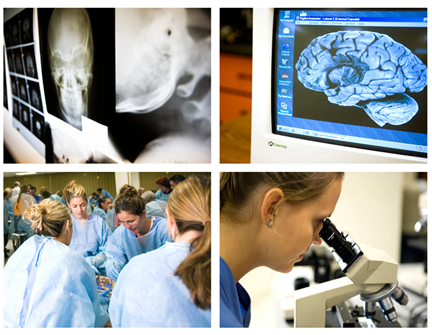
This course consists of an exciting three-day anatomical dissection of the brain and spinal cord, as well as a compelling review of recent advances in functional neuroscience. Participants will work in groups (3) and will be allotted three afternoons to perform regional dissections on embalmed human cadaveric material. The faculty will consist of neuroscientists and clinicians qualified and experienced as neuroanatomical instructors. Faculty members will guide 12 hours of dissection in the afternoons. These sessions will be complemented by three morning lecture sessions enriched by slide, video, computer animation and microscopic presentations.
Course Objectives
- Locate and discuss all major gyri and sulci of the cerebral cortex; explain functional specializations of the primary visual, somatosensory, motor, auditory, speech and olfactory cortices
- List blood vessels forming the Circle of Willis on a human brain specimen and locate common sites of cerebrovascular accident
- Identify and explain the three-dimensional organization of major cerebral association, commissural and projection fiber systems
- Locate and identify the ventricular system in three dimensions and explain route of CSF circulation
- Explain the different elements comprising the meninges, including specializations that serve protective and vascular functions
- Explain the origins and functions of the 12 pairs of cranial nerves, including foramina that transmit them to the neurocranium
- Explain the major structural and functional subdivisions of the cerebellum, including major afferent and efferent pathways linking it to the brain stem
- Explain the chemical neuroanatomy of selected neuronal systems, including ascending monoamergic systems involved in mood, reward, attention and arousal
- Understand and explain the functional implications of lesions and pathologies within the neuraxis
- Identify and discuss major specializations of primary and association cortices
- Define the major parallel circuits through components of the basal ganglia, and understand the 3-dimensional relationships of the caudate nucleus, putamen, globus pallidus, subthalamic nucleus, substantia nigra and thalamus, as well as fibers coursing through the contiguous internal capsule
- Explain major elements of the limbic system, including the hippocampus, amygdala, hypothalamus and thalamus, including interconnecting fiber pathways
- Explain major ascending spinal cord pathways, tracing them from the periphery to the somatosensory cortex
- List the brain origins of major descending motor systems, including corticospinal, rubrospinal, reticulospinal and vestibulospinal pathways
- List and explain origins of major chemical neurotransmitter systems, including the basal forebrain cholinergic and histaminergic systems, as well as brainstem origins of monoaminergenic pathways
- Discuss recent findings from the field of neuroscience of particular relevance to practicing clinicians, including advances in our understanding of addiction, neuronal plasticity, stroke, spinal cord injury, schizophrenia, depression and other neurological dysfunctions
Who should attend
This provocative neuroanatomical dissection experience will prove invaluable to anyone seeking a better three-dimensional understanding of the organization of the nervous system. The course has been attended in the past by practitioners and educators from numerous disciplines, including psychology, medicine, neuroscience, physiology, physical and occupational therapy, rehabilitation engineering, anatomy, and many others.
Course schedule and content
Check-in for course 8 a.m. Thursday, July 23, 2026
Thursday, July 23
- Morning Lecture Session (TBD)
Surface Features and Meninges, Ventricular and Vascular Systems, Cerebral Cortex, Spinal Cord, Thalamus, Basal Ganglia and Cerebellum
- Lunch (included)
- Afternoon Dissection Session (Anatomy Lab, Schroeder Complex, 050)
Surface anatomy vascular system and meninges, deep white matter pathways
Friday, July 24
- Morning Lecture Session (TBD)
Limbic System, Autonomic Nervous System and Hypothalamus, Cranial Nerves
- Morning Session: Limbic System, basal ganglia and thalamus
- Lunch (included)
- Afternoon Dissection Session
Saturday, July 25
Morning Lecture Session (TBD)
Diagnostic Imaging in the CNS, Clinical Correlates of CNS Pathology
- Functional Neuroscience Breakout Sessions
Review of recent advances in neuroscience, including current issues in spinal cord injury, Parkinson's disease, addiction research, obesity, the neurobiology of schizophrenia and depressive illness, PTSD, and traumatic brain injury
- Lunch (included)
- Afternoon Dissection Session (Anatomy Lab, Schroeder Complex 050)
Brainstem and cerebellum, spinal cord, review of brain in coronal sections, review of cranial nerves, histology and chemical neuroanatomy, wrap-up and course evaluation
Faculty
William E. Cullinan, Ph.D., Course Director, received his bachelor's degree in physical therapy from Marquette University and his doctorate in neuroscience from the University of Virginia. Following a postdoctoral research fellowship at the University of Michigan, he joined the faculty in the department of Biomedical Sciences at Marquette in 1995. He also holds an adjunct faculty position in the Department of Neurosurgery at the Medical College of Wisconsin. Dr. Cullinan has established an active research laboratory investigating the neural circuitry mediating stress responsiveness, currently funded by the National Alliance for Research on Schizophrenia and Depression (NARSAD), and the National Institute of Mental Health (NIMH). The author of many research papers and book chapters, he presently teaches anatomy and neuroanatomy to undergraduate and professional students, and to medical students and residents.
James P. Herman, Ph.D., will serve as lecturer and laboratory faculty member. Dr. Herman received his doctorate in neurobiology from the University of Rochester and completed a postdoctoral research fellowship at the University of Michigan. He is presently professor of psychiatry at the University of Cincinnati Medical School. Dr. Herman is the director of a neurobiology laboratory supported by several grants from the National Institute of Health and the National Science Foundation to examine stress effects upon the limbic system, and the function of stress hormones in the context of mental illness. He has authored numerous research papers and chapters and has taught anatomy and neurobiology to medical and graduate students.
Robert C. Thompson, Ph.D., will serve as lecturer and laboratory instructor. Dr. Thompson received his Ph.D. from the Oregon Health Sciences University and completed a postdoctoral fellowship at the University of Michigan. He is currently a faculty member in the Department of Psychiatry at the University of Michigan, where he is co-director of the Gene Microarray Laboratory. His research interests concern the molecular biology of psychiatric illness, currently funded by the National Institute of Health. The author of numerous research articles and chapters, Dr. Thompson is also an experienced neuroanatomical instructor, and presently lectures to graduate students and medical residents.
Additional faculty experts to be announced.