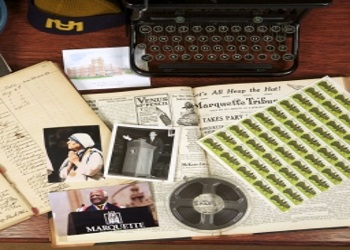
SISTER/RELIGIOUS FORMATION CONFERENCE RECORDS
Historical Note / Scope and Content Note
Historical Note
The Sister Formation Conference was founded in 1954 in response to concerns about the inadequate education of women religious, many of whom taught in parochial schools. Over the next decade this "grassroots" organization helped bring about a dramatic change in the status of these women within the Catholic Church and within American society as a whole, by such means as the Sister Formation Bulletin (the first publication "by sisters, for sisters," in the words of its editor, Sister Ritamary Bradley) and workshops on spiritual and professional formation. Its name changed in 1976 to reflect the addition of men formation personnel to its membership. The Religious Formation Conference presently administers programs related to initial and ongoing formation from its headquarters in in Chicago, Illinois.
For further information see:
- Beane, Marjorie Noterman. From Framework to Freedom: A History of the Sister Formation Conference.
Lanham, MD: University Press of America, 1993. - Eby, Judith Ann. " 'A Little Squabble among Nuns'? The Sister Formation Crisis and the Patterns of Authority and Obedience among American Women Religious, 1954-1971. " Ph.D. dissertation, St. Louis University, 2000.
- Kennelly, Karen. The Religious Formation Conference, 1954-2004. Silver Spring, MD: Religious Formation Conference, 2009.
- Schneider, Mary. The Transformation of American Women Religious: The Sister Formation Conference as Catalyst for Change (1954-1964). South Bend, IN: Charles and Margaret Hall Cushwa Center for the Study of American Catholicism, University of Notre Dame, 1986.
Scope and Content
Series 1, National Policy-Making Bodies, 1954- , contains agendas, minutes, memoranda, reports, and correspondence concerning the Leadership Group, Sister Formation Committee, National Consultative Committee, and National Leadership Board; audio recordings of several meetings are included. The series is arranged in chronological order by date of meeting or written communication between the office and these groups.
Series 2, Conferences, Programs, and Workshops, 1956- , contains correspondence, papers, and audio and video recordings of educational sessions sponsored by the Conference, including documentation of the significant Everett and Marquette curricula workshops (1956-1963). The records are arranged in chronological order.
Series 3, Correspondence and Subject Files, 1951- , comprises the bulk of the office files maintained by the executive secretaries/directors. It consists of three subseries (1, 2, 3). The conflict between the Sister Formation Conference officers and the leadership of the Conference of Major Superiors of Women in the early 1960s over the proposed restructuring of the SFC to more directly subordinate it to the CMSW is especially well-documented in correspondence, memoranda, and reports. Other topics from this period which are covered at some length include assistance to Sister Formation groups in Latin America, relations with Anglican and Episcopal religious communities, editorial policies of the Sister Formation Bulletin, and the Sister Formation Graduate Study and Research Foundation. The series are arranged in alphabetical order by correspondent, subject, or type of record.
Series 4, Publications, 1954- , contains the Sister Formation Bulletin, Higher Superiors Newsletter, InFormation, proceedings of National Congresses and other publications, arranged in chronological order by first date of publication
Series 5, Sister Ritamary Bradley Papers, 1952-2000, contains correspondence, manuscripts, and publications pertaining to her editorship of the Sister Formation Bulletin, involvement in the SFC/CMSW conflict, and academic career at St. Ambrose College. Notable correspondents include Sister Mary Emil Penet, David Riesman, Sister Margaret Traxler, and Sister Annette Walters. The series is arranged in alphabetical order by correspondent, subject, or type of record.
Series 6, Sister Annette Walters Papers, 1936-1983, are private papers of the second executive secretary of the SFC (1960-1964), documenting her continuing dissent from the the philosophy and practices of the Sister Formation leadership after she left office. Included are an oral history of the conflict (1964-1965) and a 600-page typescript account, "Renewal and its Counterfeits: A Squabble among Nuns?" (1969), both undertaken in collaboration with her assistant, Sister Ritamary Bradley. There are also files pertaining to Walters' academic career as a clinical psychologist and her sex discrimination suit against St. Ambrose College. Notable correspondents include Florence James, Sister Anne Catherine McDonald, Michael Novak, Mother Gemma Piennett, David Riesman, and Sister Mary Luke Tobin. The series is arranged in alphabetical order by correspondent, subject, or type of record.
Series 7, Sister Emmanuel Collins Papers, 1960-1967, contains Sister Formation-related correspondence of a member of the National Sister Formation Committee who was involved in the revision of the SFC's bylaws.
Series 8, Curated Website Captures, 2011-, provides access to versions of the RFC's website.