Basic Rifle Marksmenship
This year, the Golden Eagle Battalion was able to extend its Spring Field Training Exercise into three days instead of the traditional two days in order to incorporate more training for the cadets. The battalion began preparing for the extended weekend weeks ahead of time, with Pre-Combat Inspections and Pre-Combat Checks that ensured all cadets had all the materials they needed for the weekend. Well ahead of time, the cadets were aware of the weekend’s individual training events and what to expect in terms of assigned leadership. This assigned leadership was a crucial part of the entire weekend and allowed a majority of cadets, juniors, sophomores and even some freshmen to get a chance leading not only their teams of four people or squads of about ten, but also platoons with more than 20 cadets total.
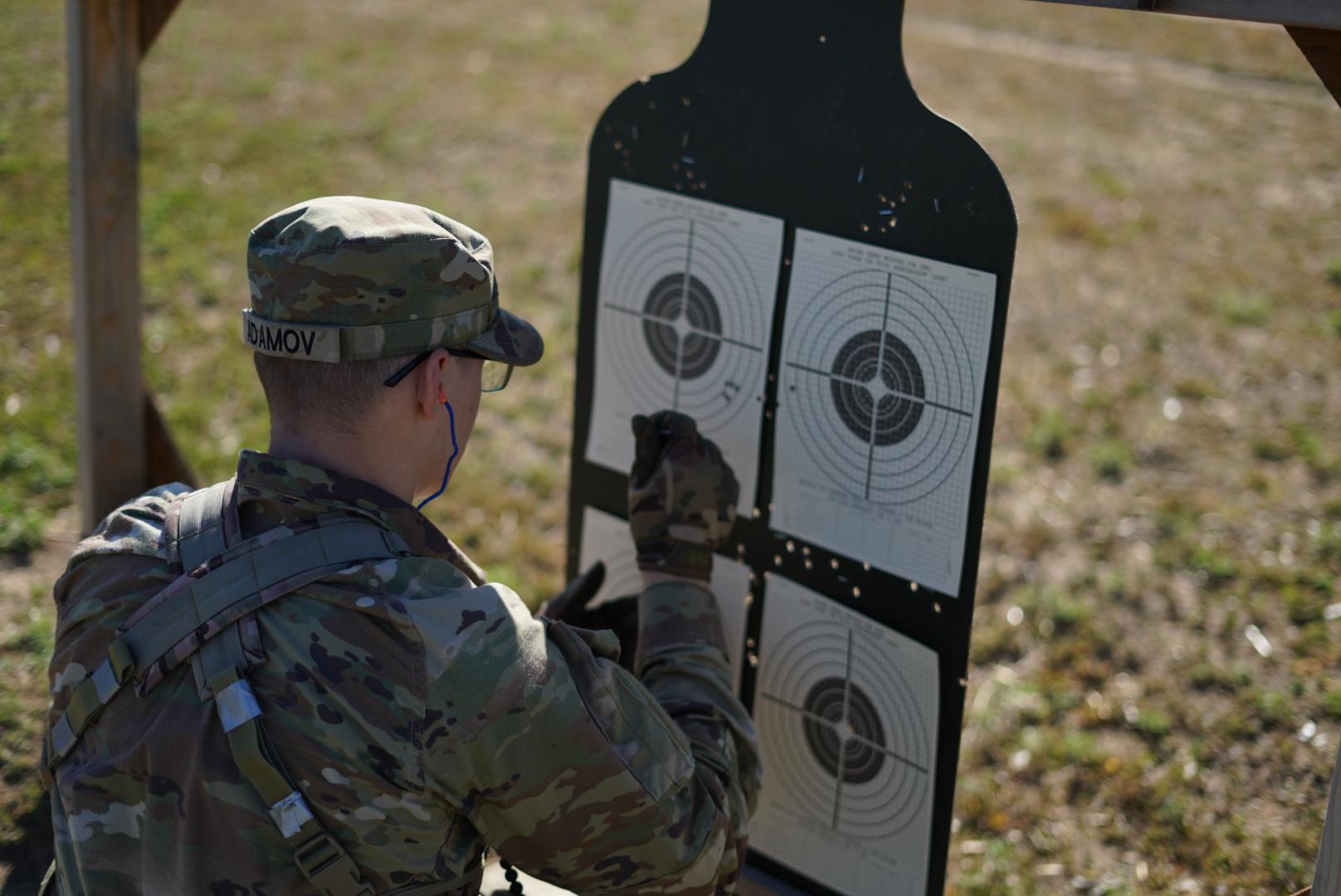
Friday began early with a departure from Marquette at six in the morning to ensure a timely arrival at Fort McCoy, near LaCrosse, Wis. The majority of Friday was spent training with the M-16 rifle on firing ranges. First, the cadets were able to “zero” their weapons, which allows them to adjust all of the sight pictures to fit them each personally. Once the cadets were zeroed, they travelled to the record fire range.
The record fire range was a pop-up target range that was able to test each cadet on their basic rifle marksmanship. During the record fire, cadets are given 20 rounds for their weapon
in order to familiarize themselves with pop-up targets down range. They are also given the additional 40 rounds which will be used to essentially “grade” their record fire.
Out of 40 possible pop-up targets that the cadets tried to shoot, twenty of them were shot while in the prone position while supported, 10 were shot while in the prone position unsupported
and the final 10 shots were in kneeling position.
In order to qualify, cadets had to hit at least 23 targets out of the 40 that popped up on the range.
After all cadets were given a chance to qualify on the record fire range, the juniors split apart from the underclassmen. While the juniors did night land navigation in order to prepare themselves for the Leadership and Development Assesment Course at Fort Lewis, Wash. this summer, the underclassmen got together in their squads to go over necessary squad standard operating procedures for the next day’s training.
The next day began early for all cadets and once again, the juniors were split from the underclassmen, as they would be the rest of the weekend. While the juniors conducted day land navigation and squad situational training exercises, the underclassmen spent the entirety of the day doing six situational training exercises in their squads of about 10 cadets.
These STX lanes (as they are called) prepare cadets not only for basic battle techniques and tactics, but also allow cadets to develop their leadership skills as they are put in positions such as squad leader or team leader.
Saturday night ended with a trip to the DFAC for a warm dinner and then weapons cleaning back at the barracks. On Sunday morning, the juniors departed early yet again to do a patrol STX lane. This differs from a squad level STX lane in that the size of the element is doubled. Instead of 10 cadets, there are now about 20. At the same time, the underclassmen were at a different training location doing the Field Leadership Reaction Course, which can be compared somewhat to an obstacle course. Underclassmen were given leadership positions and had to develop a plan on how to get past each obstacle using their squad members.
Overall, the weekend was a success. A majority of the cadets were able to qualify on the M-16, all cadets were familiarized with basic battle techniques and most importantly, the cadets were able to have fun, even if they were away from campus.