ABOUT OUR OFFICE
ABOUT OUR OFFICE
MARQUETTE'S MISSION
PROGRAMS AND EVENTS
GRANTS
MISSION WEEK
MISSION REFLECTIONS
MISSION AND ACADEMICS
CONTACT US
BACK TO HOME


Who was St. Ignatius?

Web Posted: July 28, 2003

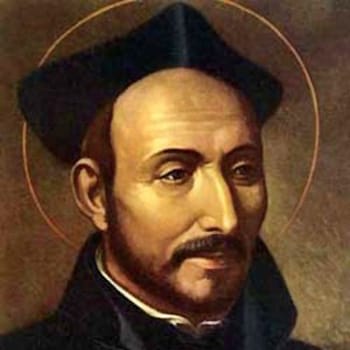
July 31 is the feast day of St. Ignatius of Loyola, founder of the Jesuits. We at Marquette refer to ourselves as a "Jesuit university" or having an "Ignatian spirituality" or vision. But who was Ignatius, and what is it about him that still attracts and inspires us in this university community? Getting to know Ignatius can be much like discovering the stories of our own ancestors. While we do not expect to emulate them in every detail, their lives provide a context and direction for our own. They root us in a purpose larger than ourselves. This week's mission reflection offers a very brief glimpse into the early life of Ignatius of Loyola -- pilgrim, visionary, servant and leader -- whose "yes" to God reverberates still in the work, mission and community that is Marquette. Ignatius

Iñigo Lopez de Loyola was born in 1491; Loyola was the name of his ancestors' manor house and farmland in northern Spain, the Basque country. The surnames of the Basques derived from the house or estate to which they belonged. Iñigo was his given name; he later changed it to Ignatius, probably out of admiration for the great Christian martyr Ignatius of Antioch. Ignatius is not, as many suppose, a translation of the name Iñigo to another language.

His family was large and wealthy. Iñigo and his brothers were, in various capacities, in service to the king of Castile. The young Iñigo might best be described as a courtier; some writers refer to him as a knight. His earliest biographer, Ribandeneira, describes him as "a lively and trim young man, very fond of court dress and good living."

Iñigo, although never a full-time professional soldier, is often referred to as the Soldier Saint. He was seriously wounded by the French at Pamplona in May of 1521 when a cannonball shattered his right leg and wounded his left. Immediate medical attention was crude, hasty, and obviously ineffective; he was sent home on a litter to the castle of his ancestors. The bones, Iñigo writes in his third-person Autobiography, "either because they had been badly set or because the jogging of the journey had displaced them, would not heal. Again he went through this butchery [a reference to the repeat surgery] in which, as in all the others that he suffered before or after he uttered not a word nor showed any sign of pain other than the tight clenching of fists." During a long recuperation, the future saint had what he describe as his first reasoning, his first reflective experience, on the things of God....

Upon recovery from his wounds and related illness, Iñigo resolved to follow Christ. He made his way to the Benedictine monastery at Montserrat in Spain, sought out a confessor, and unburdened his soul in a three-day general confession. Then he hung up his sword and dagger -- emblems of a swashbuckling past -- at the famous Montserrat Marian Shrine of the Black Virgin.... His intention, according to a recent historical account, was "to clothe himself there with the arms of his new spiritual warfare, in the fashion of young knights who entered upon the service of earthly warfare."

He left Montserrat intending to go directly to Barcelona to board a ship for the Holy Land to visit -- as he had resolved to do during his recuperation- the places made holy by the footprints and eventually the blood of Jesus. But he delayed for eleven months in the village of Manresa (another famous place name in Jesuit history), about twenty miles from Montserrat, where he experienced interior trials as well as divine illuminations. At Manresa, he underwent a spiritual transformation, an experience he would later draw upon in producing his Spiritual Exercises, a handbook intended to serve as an outline for a month long retreat. He would later invite Fancies Xavier and other individuals of "magnanimity and generosity" to make the Exercises, which were designed to help them, by God's grace, become even more generous. In the introduction to his handbook, Ignatius writes, "We call Spiritual Exercises every way of preparing and disposing the soul to rid itself of all inordinate attachments, and, after their removal, of seeking and finding the will of God in the disposition of our life for the salvation of our soul" (spEx, 1). The salvation of others -- what Ignatius constantly refers to in later apostolic planning as the "help of souls," or service -- was never far from his thoughts. But the beginning experience of the Exercises focuses on the cultivation, by God's action in the soul, of a fuller freedom and closer union with God on the part of the one who would be, in the Ignatian mode, a follower of Christ. Ignatius had a vision, a commitment, and a pattern of living that eventually became known worldwide as the Jesuit way of life. Every Jesuit school, college, and university has been touched by the influence.

Several short paragraphs at the beginning of the book constitute what Ignatius calls the "First Principle of Foundation" of the Spiritual Exercises. These words have been pondered often and deeply by every Jesuit throughout his Jesuit life. They help to explain why Jesuits do what they do, including establishing the institutions that bear the name Loyola. These words can serve as a personal mission statement for those who see life and faith from a Jesuit perspective. Here is what Ignatius would say to a young graduate or anyone associating him- or herself with the Jesuit work:

You are created to praise, reverence, and serve God your Lord, and by this means to save your soul.

The other things on the face of the earth are created for you to help you in attaining the end for which you are created.

Hence, you are to make use of them in as far as they help you in the attainment of your end, and you must rid yourself of them in as far as they prove a hindrance to you.

Therefore, you must make yourself indifferent to all created things, as far as you are allowed free choice and are not under any prohibition. Consequently, as far as you are concerned, you should not prefer health to sickness, riches to poverty, honor to dishonor, a long life to a short life. The same holds for all other things.

Your one desire and choice should be what is more conducive to the end for which you are created. (spEx, 23)

It takes spiritual maturity to catch the Ignatian vision, to see "First Principle and Foundation" as a basis for living, as a focus that helps you find God and God's love in all things. It takes additional spiritual maturity to be willing to make your own the famous Ignatian prayer for generosity; "Dear Lord, teach me to be generous; teach me to serve you as you deserve to be served; to give and not to count the cost; to fight and not to heed the wounds; to toil and not to seek for rest; to labor and not to ask for any reward, save that of knowing that I am doing your will, O God."

The man who was Loyola had a tendency to see life as a struggle between the forces of good and the forces of evil. He was a mystic who saw the world from God's point of view. He founded his religious order -- the Jesuits -- for like-minded men called, as he was, to be contemplatives in action. Ignatius and his first companions committed themselves "to travel anywhere in the world where there is hope of God's greater glory and the good of souls." The phrase God's greater glory appears on the logo, the coat of arms, of many Jesuit institutions and organizations: Ad maiorem Dei gloriam. Ignatius understood that the greater glory of God involves a greater, more generous, and selfless service to others. For Ignatius, the help of souls meant the help of bodies too. Just as Mother Teresa of Calcutta did in the late twentieth century, he always sent his men to minister in hospitals, care for the poor, protect prostitutes and marginated people, and instruct unsophisticated children in religion.

Graduates leaving Jesuits campuses today are encourage not to leave that spirit behind. In fact, they are often urged to take it upon themselves to learn more about the man and his vision. There are good biographies to be read. There are the Spiritual Exercises to be made (experienced, not read) at a Jesuit retreat house. ... Moreover, if a person catches the Ignatian vision, the spirit of the man who was Loyola, he or she may be moved to pray from time to time as Ignatius prayed at the commencement of his apostolic life:

Take, Lord, and receive all my liberty, my memory, my understanding, and my entire will, all that I have and possess. You have given it all to me. To you, Lord, I return it. All of it is yours; dispose of it wholly according to your will. Give me only your love and your grace, and that will be enough for me.

Excerpted from Jesuit Saturdays: Sharing the Ignatian Spirit with Lay Colleagues and Friends by William J. Byron, S.J. (Loyola Press 2000). Reprinted with permission of Loyola Press. To order copies of this book, call 1-800-621-1008 or visit Loyola Press.


Home Marquette Home
All Material © 2006 Marquette University.
P.O. Box 1881 - Milwaukee, WI USA - 53201-1881 - (414) 288-7250