The Power of Hope
Web Posted: September 14, 2004
In part, Jonathan Safran Foer’s 2002 novel, Everything is Illuminated,
tells the story of the residents of an 18th century Ukrainian village. One
scene describes a statue placed in the town’s mill that becomes a talisman
for the people of the village: they go to it with hopes and prayers, large
and small. Villagers touch the statue so much during their visits over the
years that the statue is often in need of repair, and each repair leaves the
features of the statue somewhat altered. Safran writes of the statue: “He
was a changing god, destroyed and recreated by his believers, destroyed and
recreated by their belief.”
Hope is such a powerful force! Walking across
campus, especially at the beginning of each semester, the feelings of hope
and optimism are often palpable, aren’t
they? Think about how many different “hopes” walk around the
campus every day. Hope for a good grade. Hope for a successful research project.
Hope
for people met in service. Hope to make new friends. Hope for a win in the
big game. Hope for a great job after graduation.
Some students share their
hopes with us—in papers, applications, interviews.
Some hopes are communal, shared by many; some are unique and privately
held. Some we can guess, such as the hope of being recognized for our best
elements,
the hope of doing well. Some hopes are borne out of deep fears and vulnerabilities,
such as the hope of meeting expectations.
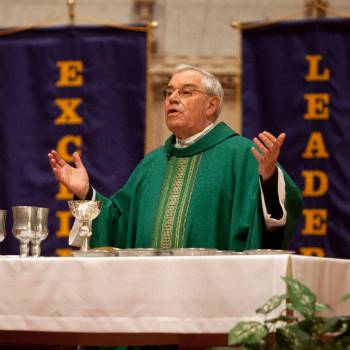
During Mission Week, we are called
to reflect on how we live out the Marquette University Mission, how we
give tangible expression to Excellence, Faith,
Leadership and Service. Sometimes, these pillars of the Mission might
appear static, and
not open to change. Yet, as I consider the notion of the statue in the
mill, destroyed and recreated by belief and believers, I am struck by
the image
of community hopes and prayers transforming a beloved community symbol.
Isn’t
this transformation what our Mission, with our commitment to each student,
calls us to as well? Our community, grounded in our Ignatian vision and
our particular mission, is committed to listening for and nurturing these
hopes,
to honoring these dreams, and to being open to change and re-creation
because of them.
As we celebrate “Hope & Freedom” during
Mission Week, how do we let these hopes express themselves? Are we open
to sit and listen to our
students—to find out about their hopes for themselves and their
world? Are we open to change based on those hopes?