Alumni Magazine, Fall 2026

The Season That Changed Marquette History

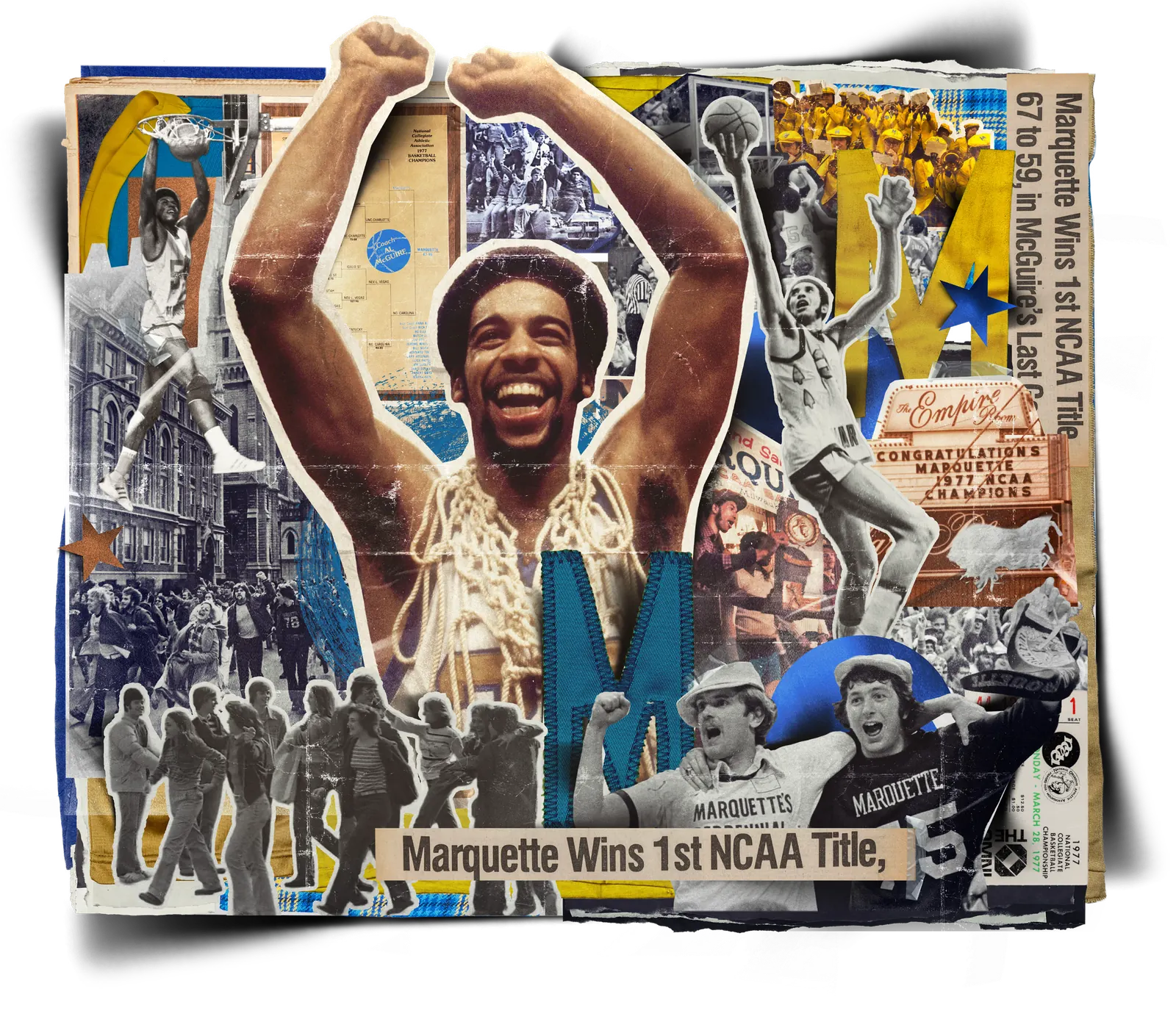
Fifty years ago, Al McGuire’s last team won Marquette’s first NCAA championship. Scroll to experience the 1976–77 season in 10 timeless scenes.

Start reading
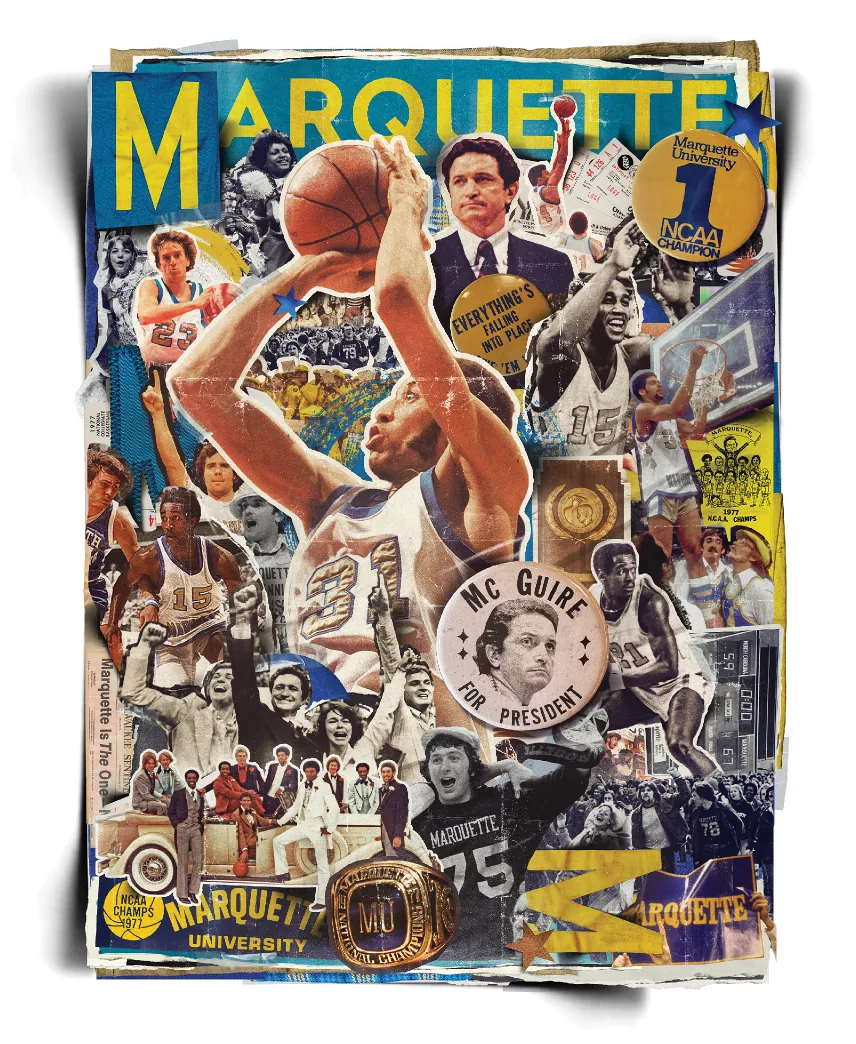
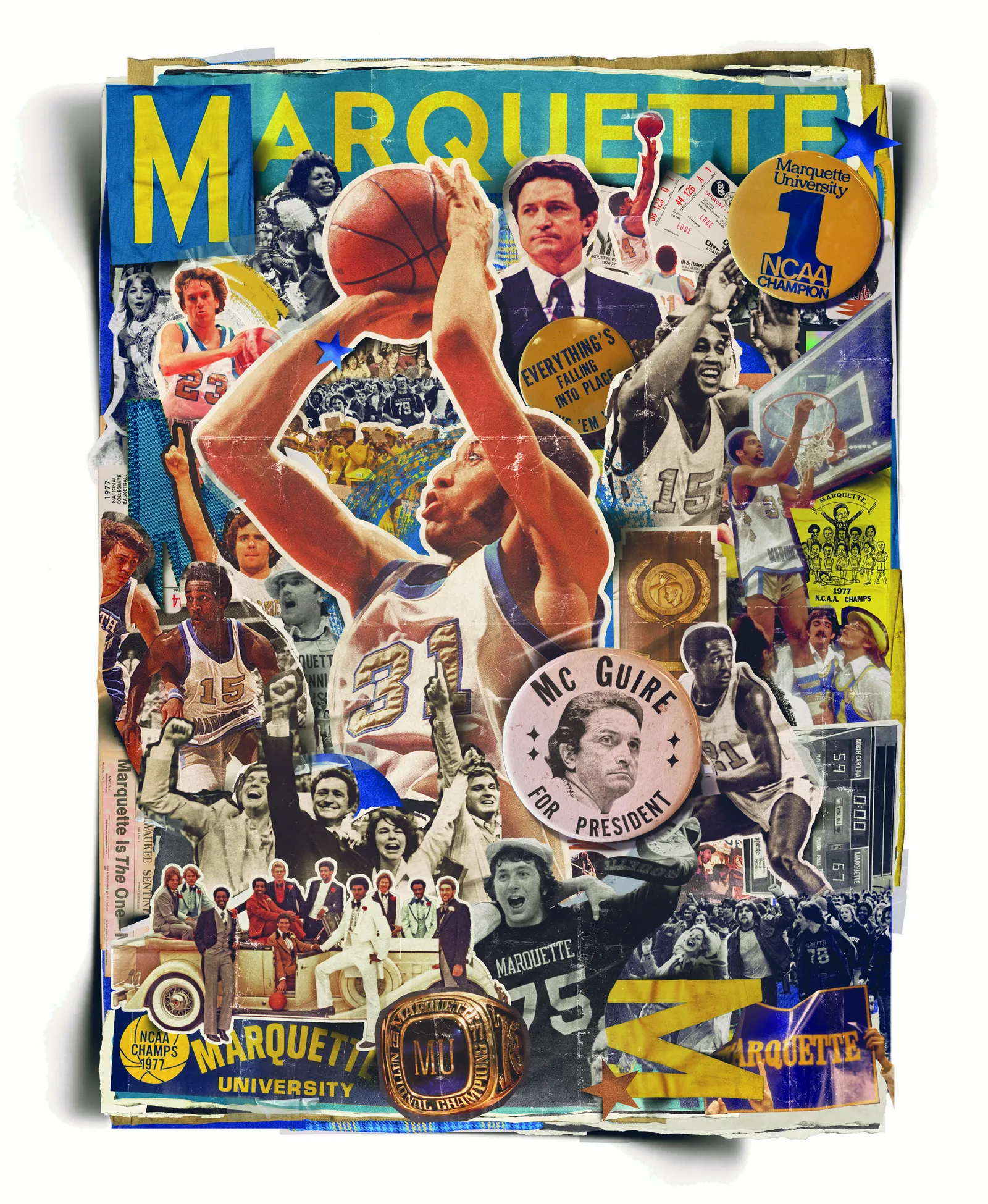
Magazine cover collage of the 1977 championship season: a Marquette player in No. 31 shooting, Al McGuire, a “McGuire for President” button, a No. 1 NCAA Champion button, the team in tuxedos with a Packard convertible, cheering fans and a championship ring.

The night of March 28, 1977?

IYKYK.

For a generation of Marquette alumni, it’s a point fixed in time and space. Whether you were cheering in the since-demolished Omni arena in Atlanta, in the crush of revelers streaming down Wisconsin Avenue, or in a home or bar somewhere else, you remember Coach Al McGuire leading Marquette to its first — and so far only — NCAA Division I men’s basketball championship.

For generations that followed, it’s legend and lore.

So much was different then. There were only 32 teams in the field, and — after some shaky stretches following McGuire’s December 1976 announcement that he’d retire at season’s end — Marquette did just enough to earn the final bid. There was no Selection Sunday, no wall-to-wall television coverage, no “One Shining Moment.”

Instead, there was a coach who was part streetwise storyteller, part game psychologist, part ringleader with a band of players who believed in him (when they weren’t arguing with him). There was a team with a different name in those days, Warriors, and a horde of fervent fans.

One night 50 years ago, everything came together in a way that cannot be forgotten. We were battle-tested and buoyant, urban and Midwestern — with a Queens accent supplied by our leader on the last night of his coaching career. That night, we were Marquette and we were champions.


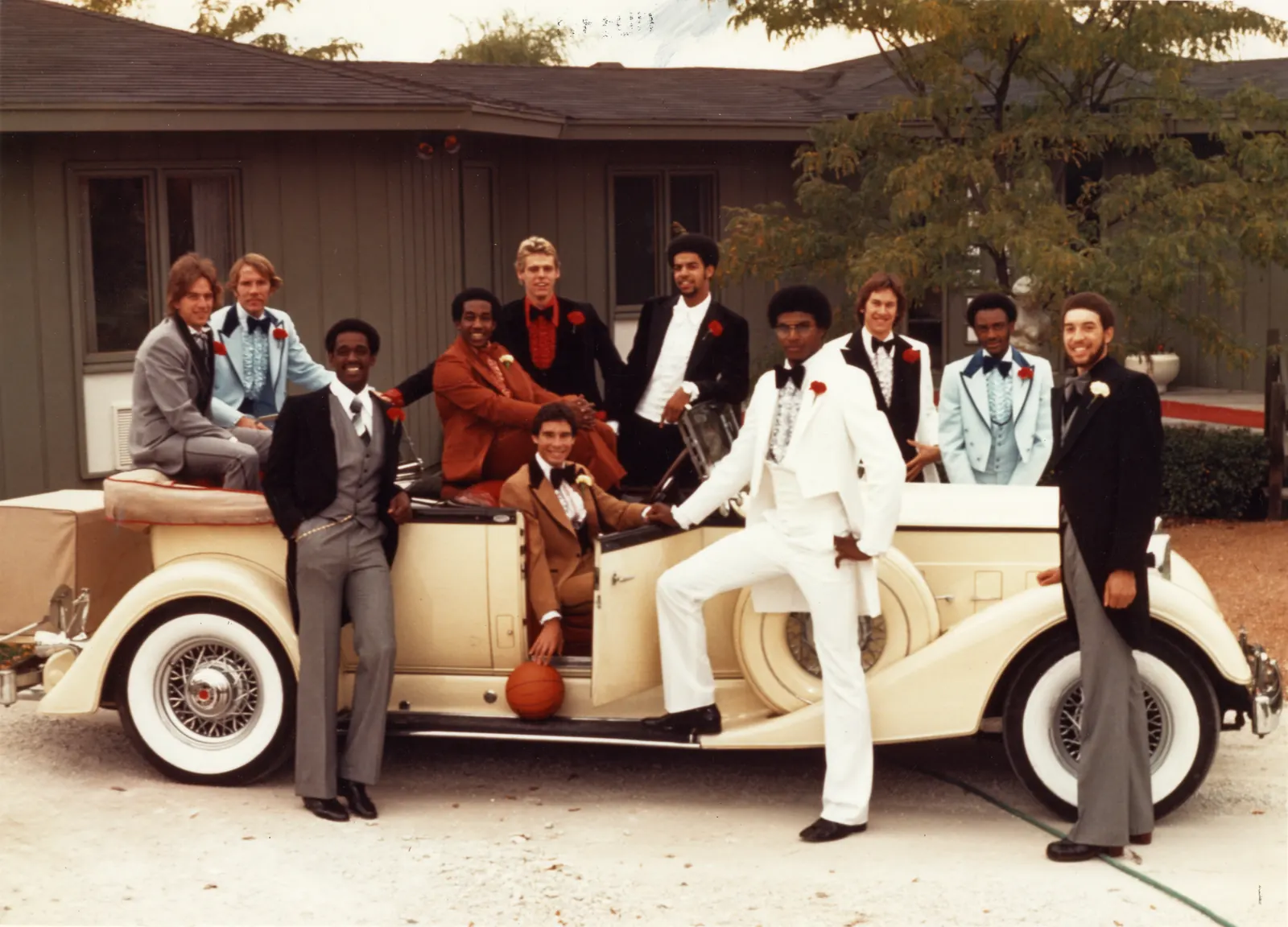
Marquette players in tuxedos pose in and around a cream 1934 Packard convertible.

No. 1

Photo Op

Even before the season started, there were indications 1976–77 would be unforgettable — like the iconic team photo featuring players in tuxedos gathered in and around a 1934 Packard convertible at the Brooks Stevens Automotive Museum in Mequon. The photo session was the brainchild of then Sports Information Director Kevin Byrne, Jour ’71.

Leaning into Marquette’s flair, under Coach McGuire, for doing things differently, Byrne hoped a photo full of style and swagger could serve as a recruiting tool. The players were all in. “We were never at a loss for being out of the ordinary,” said Maurice “Bo” Ellis, Sp ’77.

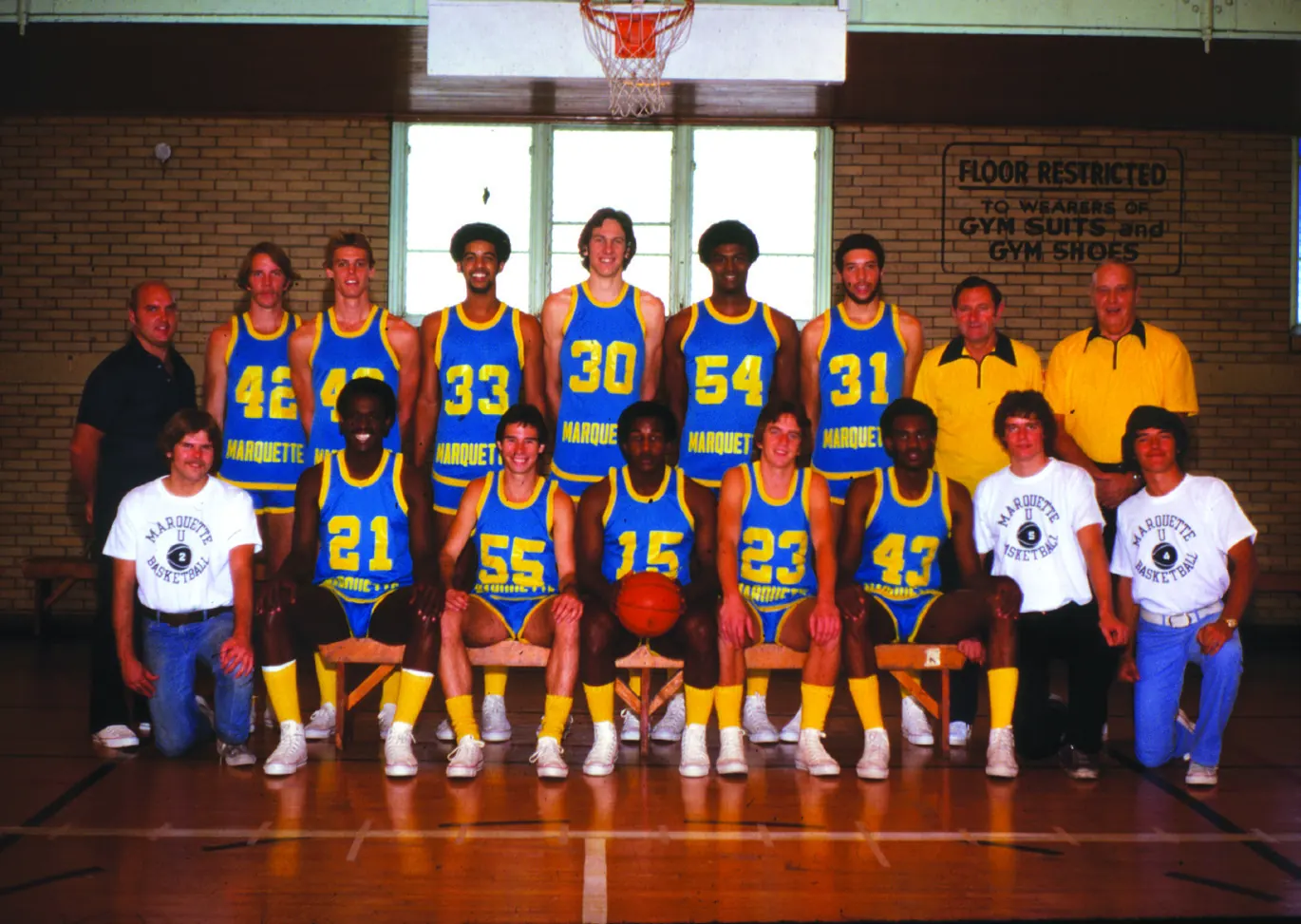
That photo featured players, but it was a surprise when the head coach missed the official team photo taken in the old gym. Byrne had thought McGuire was kidding when he had mused months earlier about wanting to retire. On the day of the photo shoot, those words returned to Byrne: “It felt like his way of saying, ‘I’m fading out of the picture.’”

No. 2

Starting Strong

in some preseason polls
No. 1
home-opener win over Saint Leo’s
80–39

Having made it to the previous postseason’s Elite 8 before falling to eventual champion Indiana, Marquette was ranked No. 1 in some preseason polls. The team’s iconic untucked jerseys designed by star forward Bo Ellis provided plenty of additional buzz. And any internal and external hiccups were minor. Fans groused when McGuire started blue-collar Bill Neary, Bus Ad ’77, Law ’80, over gifted but cocksure Bernard Toone, Sp ’79. Yet McGuire was adamant — and had a point.

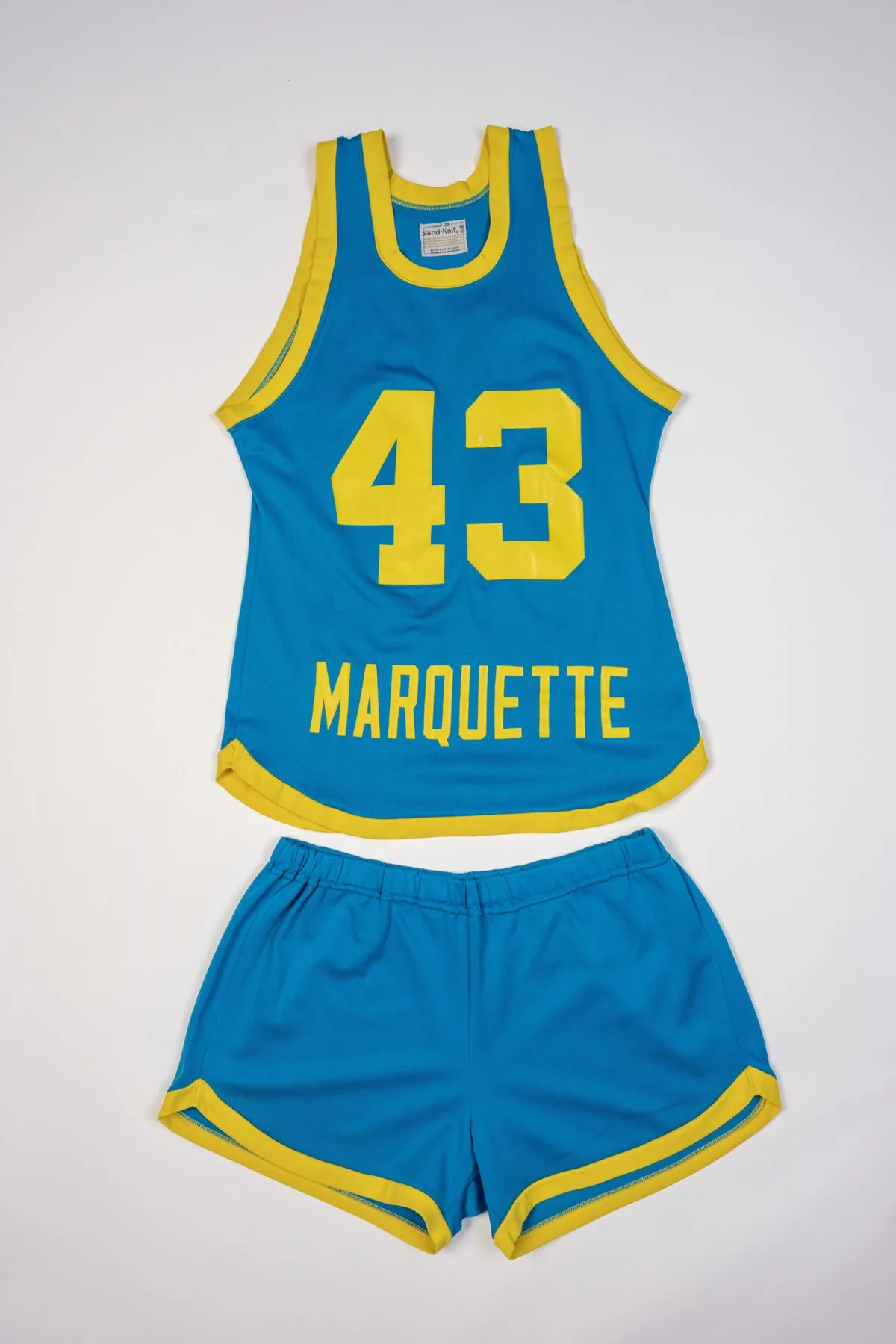
A 1970s Marquette basketball uniform laid flat: a light blue jersey with gold trim, the number 43 and “Marquette” across the front, with matching shorts.
Known for their iconic untucked jerseys designed by star forward Bo Ellis, Marquette’s players had style, talent and drive to burn. With Coach McGuire — a resourceful recruiter, fiery game manager and magnetic personality in his final year at Marquette — they rose through a season full of twists and turns.
“Nobody in their right mind would do some of the things Neary does. … If there’s ever been a guy who has gotten the most out of what he has and then some, it’s Neary. He never had the press clippings, but he had a dream. It’s nice to know there are still guys like that.”
— Al McGuire

After McGuire caused a few ripples referring to Saint Leo’s as a “cupcake,” Marquette beat them handily in the home opener, 80-39, and achieved liftoff with three more victories out of the gate.

No. 3

The Bombshell

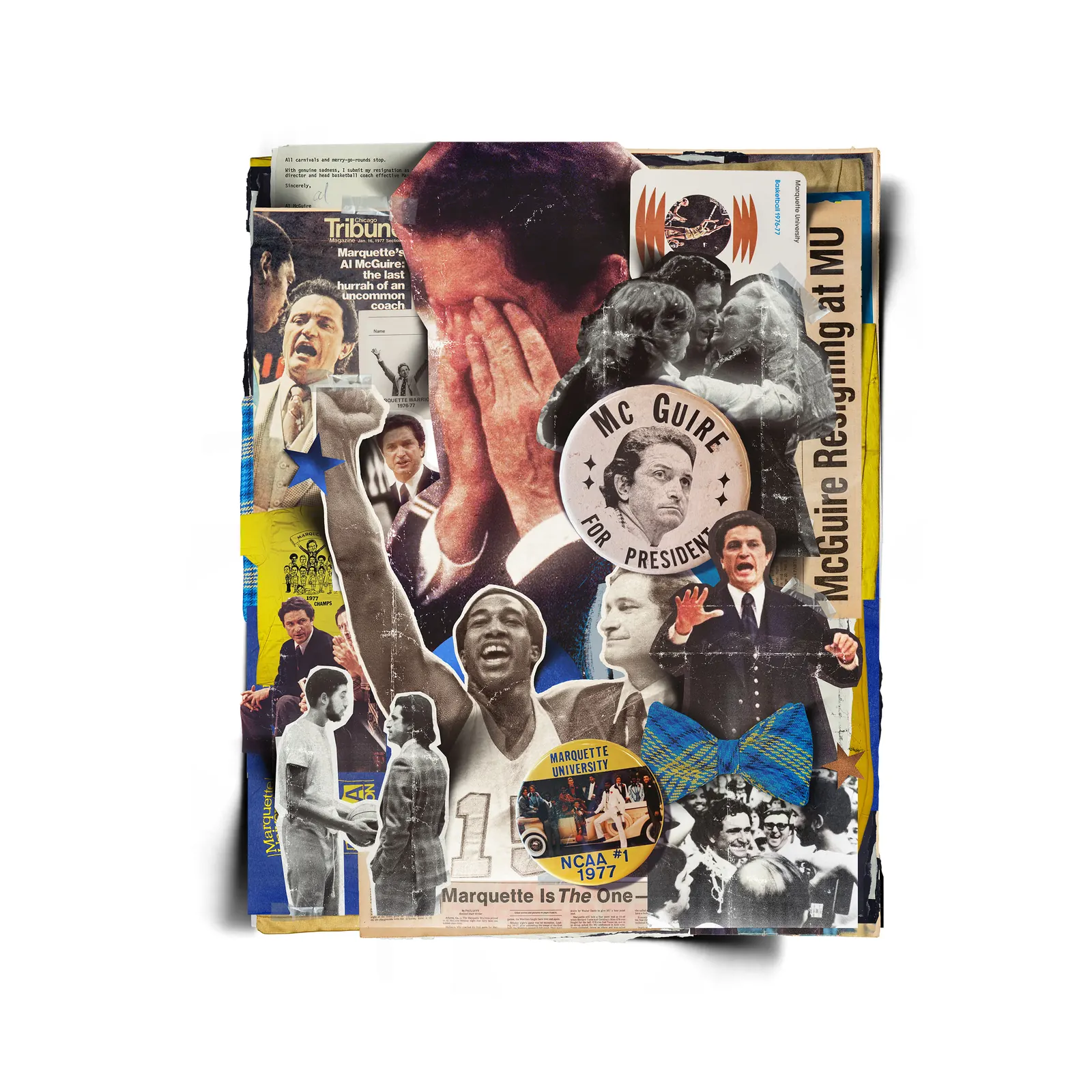
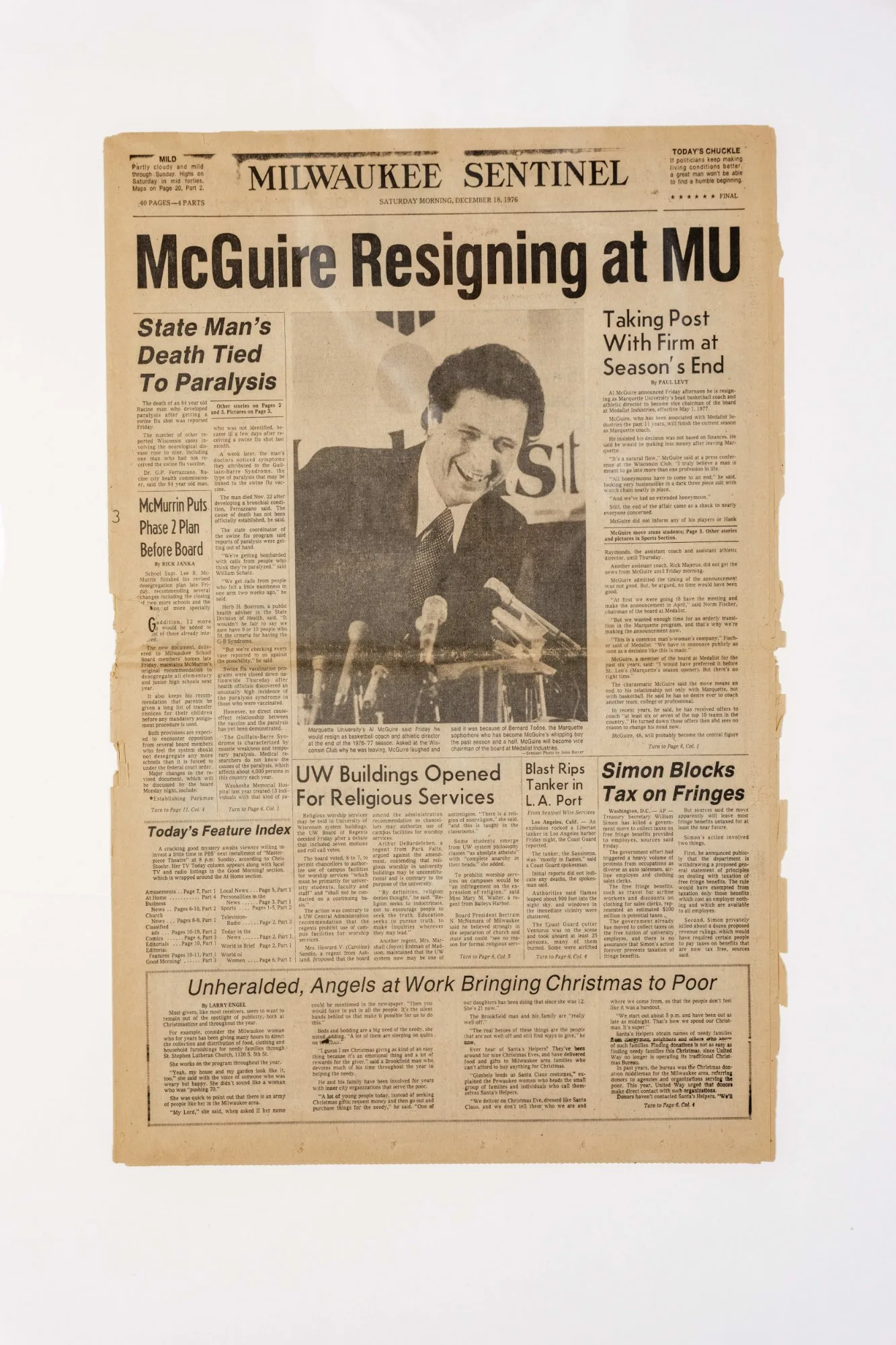
Then, the unthinkable. McGuire dropped the bomb at 4:10 p.m. on Friday, Dec. 17, 1976: This would be his last season at Marquette. He was retiring to become vice chairman at Medalist Industries, a sports uniform maker. “All carnivals and merry-go-rounds stop,” he wrote in his succinct resignation letter. “With genuine sadness, I submit my resignation.”

The coach had choked up the night before when he told his players he was leaving. None of them were there Friday for his media conference at the Wisconsin Club, where the mood in the room mirrored the cold, gray weather outside.

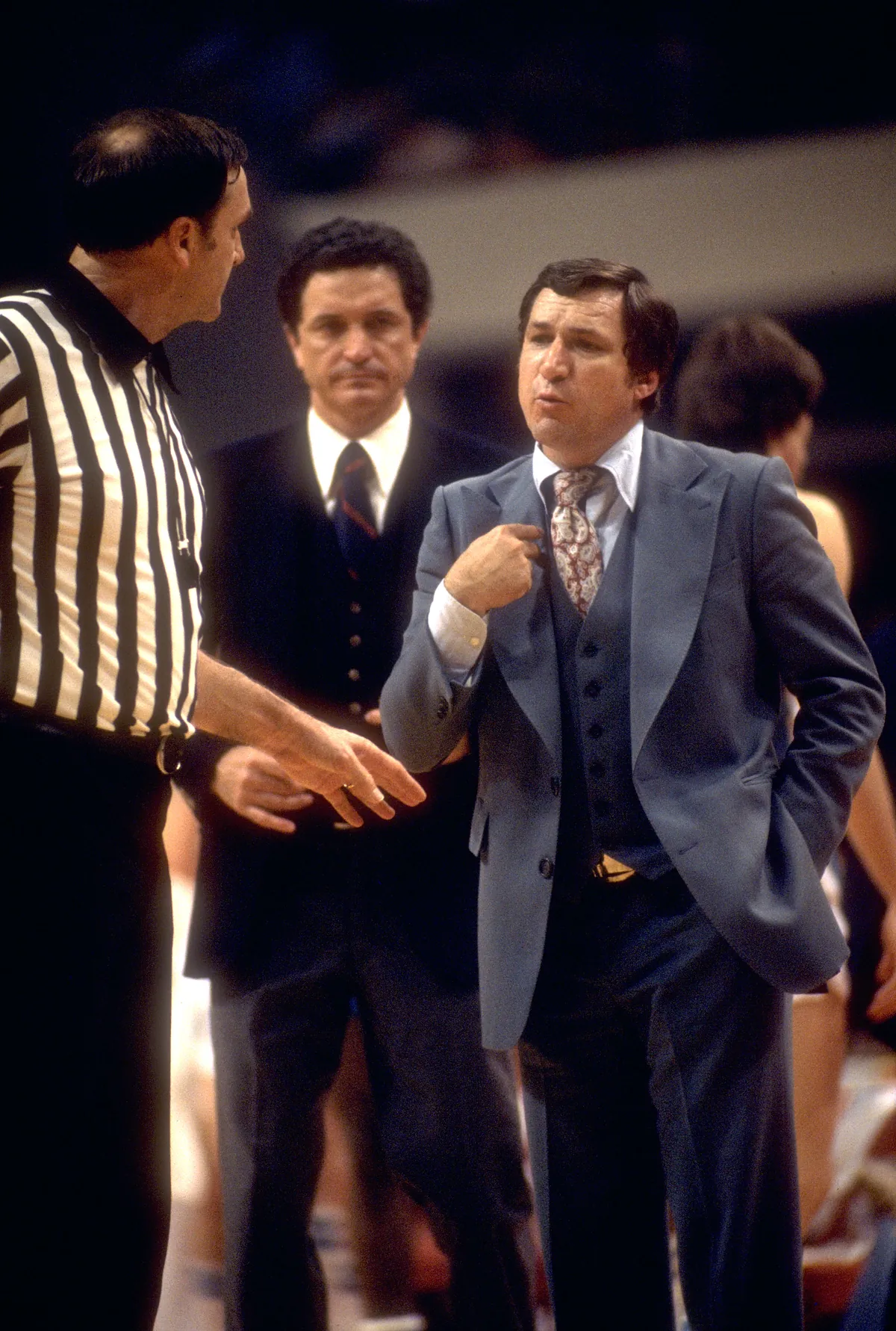
Wearing a businessman’s dark three-piece suit, McGuire tried to keep the mood light with his familiar schtick. “This is no General MacArthur speech, no ‘Old soldiers never die’ routine,” McGuire said. “I have a tremendous season in front of me. This is not a farewell, no last hurrah. But there is always a time in everyone’s life, and it’s my time to move on.”

When Byrne had a chance to ask him why, McGuire opened up:

“The kids stay 17, and I get a year older. I’m tired of telling a 17-year-old that I need him for my happiness.”

No. 4

The Nosedive

A day later, second-ranked Marquette hosted No. 17 Louisville. Alfred “Butch” Lee, Bus Ad ’78, scored 30 points but missed a free throw that would have clinched the game in regulation. An 87 percent foul shooter, Lee uncharacteristically missed two more late in overtime as MU suffered its first loss, 78-75, ending its 22-game home winning streak.

Against visiting Minnesota three days later, Marquette got booed off the court at halftime, trailing 37-18. The team got within two late in the game, but Ellis fouled out trying to block a shot and picked up a questionable technical foul en route to the loss.

Lee was asked if McGuire’s resignation had anything to do with the dip. “The players have talked about it,” he said. “Nobody is going to come out and say whether it is or isn’t. But something is wrong. I guess only time can tell. But I do feel this is the best team in the country [and] we’ll come back and win the NCAA.”

No. 5

The Recovery

W 67–49 vs. No. 11 Clemson

Looking to regain its footing, Marquette did so in a big way, clobbering towering Tree Rollins and 11th-ranked Clemson, 67-49, in the annual Milwaukee Classic. “These past seven days paid off for us,” Ellis said. “We had a meeting and did a lot of soul searching. We finally realized we have to put out 200 percent to be a great team.” With a 64-57 victory over archrival Wisconsin in the Classic championship the next night, MU was on its way to a 10-game winning streak.

The good vibes faded away quickly, though, as the team went on a three-game skid — against DePaul, Detroit and Wichita State — to close out the home portion of the schedule. After edging Marquette at the buzzer, Detroit coach Dick Vitale twirled his sport coat and danced at half-court. He still calls it his greatest college coaching victory. Perhaps fittingly, in his final home game, McGuire picked up two technicals against Wichita State and was ejected, prompting one final round of the enduring chant, “Give ’em hell, Al.”

No. 6

The Lucky Sport Coat

Desperate times called for desperate measures. The final home loss dropped Marquette to an underwhelming 16-6. Faced with five road games to close the schedule, the coach found a secret weapon — a black sport coat that was part of a three-piece outfit he chose for a 73-58 victory at Wisconsin on Feb. 21. That started the run, so he wore it at Virginia Tech, Tulane and Creighton, too. The superstition around the “lucky suit” became a story. “I used to stand in the corner and jump in and out of it,” McGuire joked about his ripe apparel. “In fact, it became the job of the 12th guy to carry it on and off the bus.”

The suit had one last bit of luck left in it. McGuire donned it at Michigan on the season’s final day. His team led by five at halftime when he learned MU had secured the 32nd and last NCAA bid. Following some celebratory hugs from sweaty players, he changed clothes for the second half — and they lost, 69-68. But his team was in.

No. 7

Emotions Run High

Season-long friction between McGuire and Toone over playing time boiled over in the tournament opener versus Cincinnati in Omaha, Nebraska. The coach yanked the sophomore forward late in the first half, and Toone cursed him as he stalked to the bench.

Uh oh: McGuire heard it. At halftime, he rushed at Toone in the locker room, and the exchange got physical. Assistant Rick Majerus, Arts ’70, Grad ’79, separated them, ushering Toone into a crowded hallway near the press room. Rather than derailing MU’s postseason, the fracas galvanized the group, which turned a three-point halftime deficit into a 66-51 runaway.

Five days later, emotions roiled again. During a round-of-16 game against Kansas State in Oklahoma City, a game official mistook McGuire’s choking gesture — a sign to his players the Wildcats were tightening up — as criticism and whistled the coach for a technical foul.

Given McGuire’s history of technicals (so costly in the 1974 title game), he had endured similar storms and felt vulnerable to be the late-game focus again. “Hank, if we lose,” he said, leaning toward assistant Hank Raymonds. “I’m finished for life.”

A 67-66 escape seconds later earned the team a reprieve and left McGuire erupting. “I’ve been through this [bleep] too many times in the NCAA,” he said in an epic seven-minute rant to the media. “[And every time], they end up calling technicals on me.” Eventually McGuire wound down:

“So, peace. I’m sorry and so on, but I’m glad I got it off my chest. It’s about time for some people to realize that I’m not a bum in a bowery, a wino in a hallway or a pimp on a corner. I know my profession. All my life I’ve worked at it hard.”

No. 8

Last-Second Elation

Scoreboard: Marquette 49, UNC–Charlotte 49. 2nd, 0:03. Tied with three seconds left.

A rare comfortable win for the blue and gold against Wake Forest in the next round was hardly a trend. Seven days later, at the Final Four in Atlanta, they were locked in a tight semifinal clash with UNC–Charlotte, the score tied, 49-49, with three seconds left. Since the team needed Lee to launch a full-court pass toward the basket, McGuire strode to the far end of the floor during a time-out to gauge the height of the hovering scoreboard.

Scoreboard: Marquette 49, UNC–Charlotte 49. 2nd, 0:03. Lee’s full-court heave ….

The guard’s heave cleared it safely and sailed past the intended target, Ellis, through the hands of Charlotte star Cedric “Cornbread” Maxwell to Marquette center Jerome Whitehead, Bus Ad ’78, whose dunk attempt bounced off the glass, hit the rim … and dropped through.

Scoreboard: Marquette 51, UNC–Charlotte 49. Final, 0:00. The basket is good.

After several seconds that felt endless, referee Paul Galvan emerged from the mob at the scorer’s table to signal the basket was good. The Marquette fans-and-band section exploded. “I argued so hard about the clock because I didn’t want them to get around to Jerome’s hand being in the cylinder” for a goal tend, McGuire admitted. Whitehead had the game of his life: 21 points, 16 rebounds. Maxwell, a future NBA Finals MVP, had 17 and 12, respectively.

No. 9

A Rainy Night in Georgia

Scoreboard: Marquette 39, North Carolina 27. Half, 0:00. Marquette leads by 12.

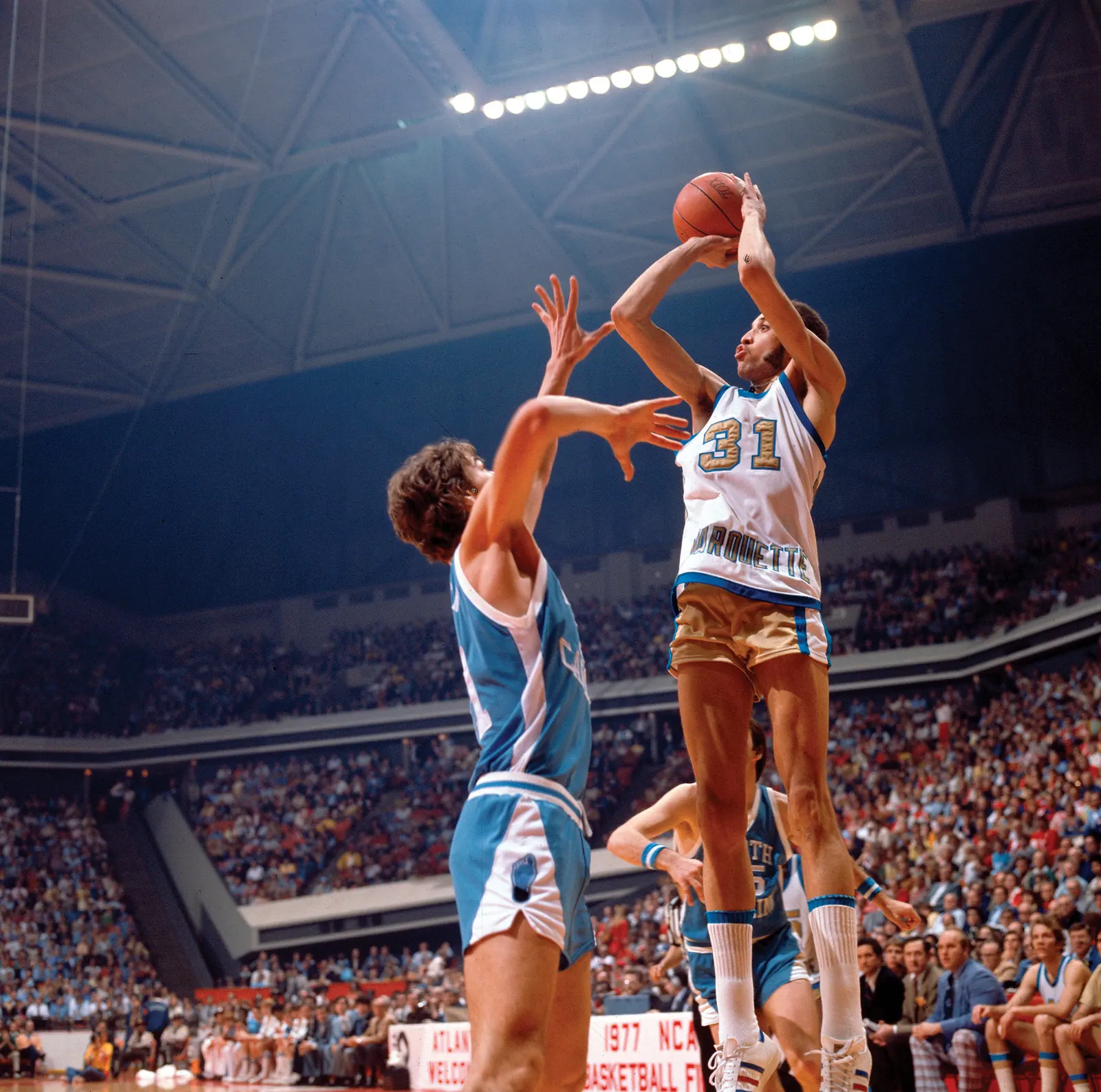
The long tortuous season, the seven defeats that made Marquette a long shot heading into the biggest game in its history — none of that mattered at Atlanta’s Omni against North Carolina’s Tar Heels. Lee, Ellis and the rest looked reborn, banking a lead of a dozen points after one half.

Scoreboard: Marquette 45, North Carolina 45. 2nd, 12:00. UNC goes to the Four Corners.

Eight minutes into the second, though, the score was tied at 45-45. That’s when UNC coach Dean Smith went to his “Four Corners” delay offense, eager to force MU out of its stifling zone defense in those pre-shot clock days.

Scoreboard: Marquette 45, North Carolina 45. 2nd, 12:00. A chess match.

This tense stretch resembled a chess match, with McGuire instructing his guys to feign just enough man-to-man to satisfy the refs’ warnings. Then they would slip back into zone, burn the clock and force UNC out of rhythm.

Scoreboard: Marquette 53, North Carolina 49. 2nd, 1:56. Marquette leads by 4.

The Tar Heels blinked first, attempting a layup that Ellis blocked. A minute later, Marquette’s Jim Boylan, Arts ’79, drove for a bucket at the other end. Two free throws by Whitehead at 1:56 nudged the lead to four.

Scoreboard: Marquette 59, North Carolina 54. 2nd, 1:00. Six straight free throws.

Smith had his players foul purposely, but Boylan and Ellis sank six straight foul shots, making it 59-54 with a minute to go.

Scoreboard: Marquette 67, North Carolina 59. Final, 0:00. Marquette, national champions.

Guard Gary Rosenberger, Bus Ad ’78, stole the ball from UNC All-American Phil Ford and found Lee for the bucket that put MU ahead by eight. That was enough. At the horn, the calliope went quiet. The merry-go-round stopped. And there was Marquette, smiling wide, the brass ring firmly in its grasp.

Collage of Al McGuire’s final season: his typed resignation letter, a “McGuire for President” button, newspaper headlines including “McGuire Resigning at MU,” and photos of the coach and his players.

No. 10

Tears of Joy

The cameras found McGuire in the final seconds of the 67-59 victory. He was crying. For years afterward, he joked it was his “million-dollar cry,” softening his image and boosting his popularity. In the moment, though, the tears represented his lifetime of battles as an underdog, his feelings for this last group that had endured so much, and more. Said Lee, “When I saw him crying with five seconds left, I elbowed Bo Ellis. I didn’t want him to miss it.”

Led to the locker room immediately afterward, McGuire dried his eyes with a towel and offered stream-of-consciousness thoughts on what had just happened: “I’m emotionally drained. … I’ve always been an alley fighter. I don’t usually get into the silk-lace situation.”

The celebration in Atlanta had nothing on the pandemonium triggered back in Milwaukee. Thousands fell in for a spontaneous march to Lake Michigan from the Marquette campus. Fans climbed atop lamp posts, piled on top of car hoods and trunks, and treated the roofs of Milwaukee metro buses like unofficial parade floats.

Back on the Omni court, players, families and students crowded around and hugged. Ellis, who started all 101 games he played for Marquette, was hoisted on teammates’ shoulders to cut down one of the nets.

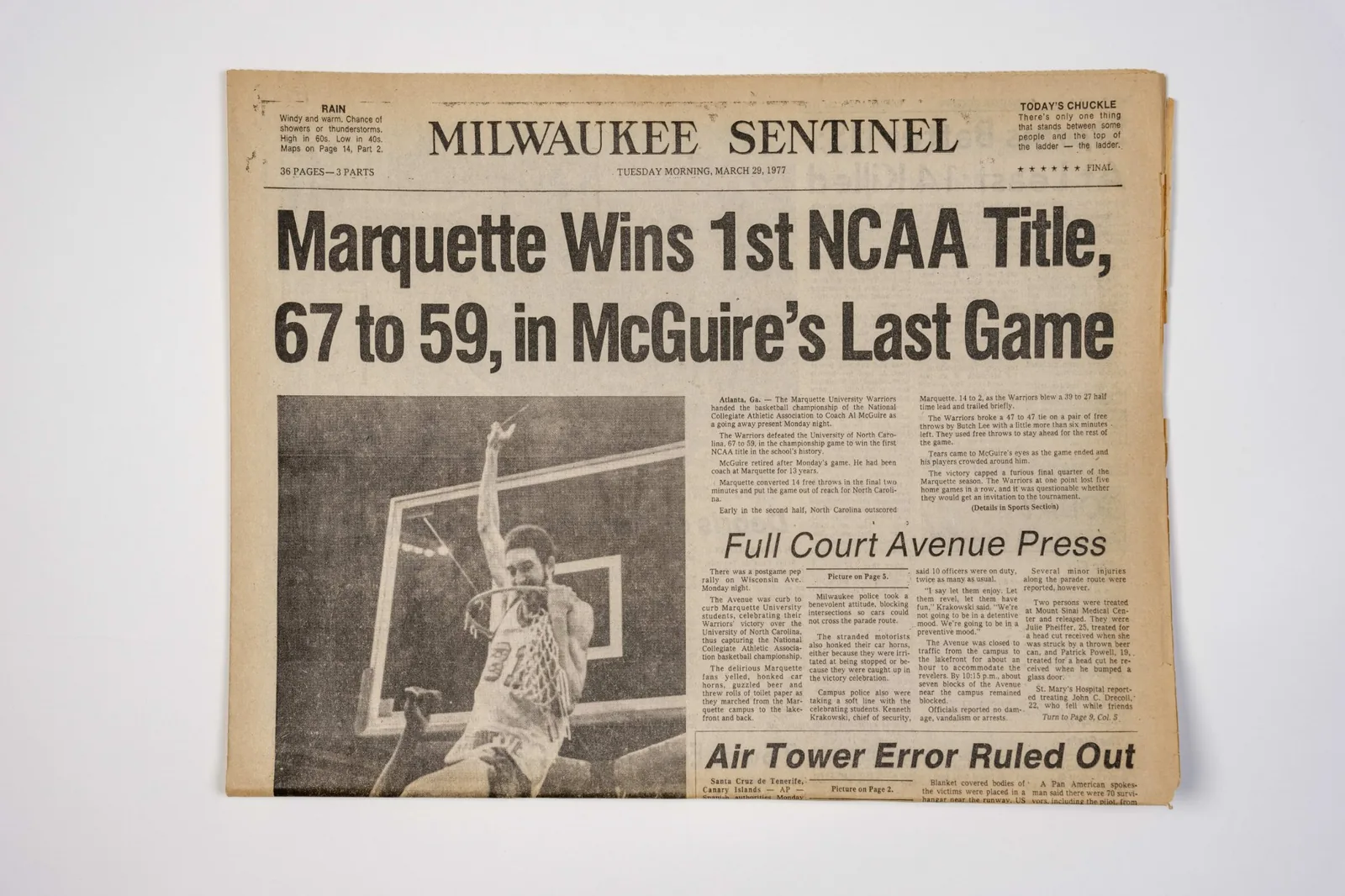
Front page of the Milwaukee Sentinel, Tuesday morning, March 29, 1977.

“We didn’t win it just because he’s leaving. We wanted it because we’re the best team.”

— Bo Ellis

What the championship means today

“Marquette’s 1977 championship is special to me. It’s a reminder of what we’re going after now. Sometimes it feels a long way away, but from what I’ve learned about that 1977 team, there were times that season when it all felt a long way away. Then, something magical happened. I’m a believer that you do everything you can and put everything in place to allow for that possibility. Then you might need some luck and good fortune — and need things to fall your way.”
Men’s Basketball Head Coach Shaka Smart
Celebrate like it’s 1977 again Learn about anniversary events for alumni and fans. mu.edu/alumni/athletics-fan-events.php

About the authors

Steve Aschburner, Jour ’78, was sports editor of The Marquette Tribune in 1976–77, covering the championship season as beat writer. For nearly 50 years since then, he has worked as a writer and columnist in sports media, most recently with NBA.com.

Mary Schmitt Boyer, Jour ’77, was the first female sports editor of The Tribune in 1976 and worked for Kevin Byrne in the Sports Information Department in 1977. The university’s 2011 By-Line Award winner, she covered Marquette for the Milwaukee Journal from 1981 to 1986 and then covered the NBA for 25 years in Minnesota and Cleveland.

Photos provided by University Archives, Raynor Library. Illustrations by Neil Jamieson.

©