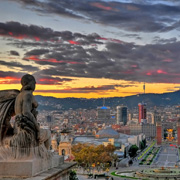



Santiago, the capital of Chile, is the political, economic and cultural center of the country. With a population of six million, it is home to nearly one third of Chile's total population and serves as one of South America’s key financial hubs. The avant-garde architectural lines of the modern constructions that make up the business district blend in harmony with turn-of-the-century buildings, such as La Moneda (Government House) and the Civic Center. This blend of modernity and tradition has given Santiago, Chile’s gateway city, its distinctive seal as a cosmopolitan city that is open to its visitors.
The imposing Andes Mountains rise majestically around Santiago. Their snow-capped summits and hills slope down to the very heart of the city. The Santa Lucía and San Cristóbal Hills, the city’s green lungs, have become favorite excursion sites for Santiago residents. Due to its geographic location, Santiago is one of the few capital cities in the world which has easy access both to ski slopes, just 25 miles away, and beaches, located 60 miles away. The city has a relatively warm climate and reverse seasons from the United States with winter beginning in June and summer in December.
The Pontificia Universidad Católica de Chile (PUC) is the largest university in South American and one of three Catholic universities in the country. This private university has four urban campuses located throughout Santiago, and its 1,800 faculty members serve 11,000 students.
This program is a great fit for students with advanced Spanish language skills, looking for an immersion experience at a Latin American university. Students engage in course work with Chilean students at PUC and also have the opportunity to participate in an optional service learning course at the nearby Jesuit institution, Universidad Alberto Hurtado (UAH).
Eligibility
Minimum Sophomore standing; 3.0 GPA; Minimum of five semesters of college level Spanish
Language
Courses are taught in Spanish
Orientation
Students participate in an on-site orientation offered to all study abroad students by PUC. In addition, students are encouraged to participate in the optional, non-credit bearing, pre-program in rural Linares that provides an intensive introduction to Spanish language and Chilean culture.
Courses Offered
All students are required to take a placement test and register for the appropriate Spanish for
Foreigners course at PUC. This course is typically the only class students take with other international students. The other courses are regular university classes with Chilean students.
In addition to the required Spanish course, students choose one of the following options:
Historic course equivalencies
Please note that the courses listed here have been approved in general for Marquette credit. However, because each individual academic record is unique, depending on the college, the major and courses taken previously, not every course will qualify to be used toward a Marquette degree. Therefore, current Marquette students must have prior approval from the their college office, before enrolling in these courses. Without this prior approval, any course taken at another institution will likely not be accepted toward the Marquette degree.
Students are responsible for making their own housing arrangements. Students can opt to live with Chilean host families in and around Santiago, as well as in apartments or student residences. OIE can provide assistance.
Students are able to study at PUC for a semester or full year. Typically the fall semester is early-July to mid-December, the spring semester is early-February to mid-July.
| Spring 2013 | Fall 2012 | |
| Pre-Program (opt.) | *Three-four weeks before classes begin | July 8-July 29 |
| Orientation | March 4-5 | July 30-31 |
| Classes begin | March 6 | August 1 |
| Exams | June 24 - July 12 | Nov. 26-Dec. 10 |
| End of Semester | July 12 | December 10 |
A student visa is required for this program. Students should start gathering visa application materials as soon as they are accepted to the program. An FBI background check is required, which takes several weeks to obtain. Generally, students are required to mail in their visa application to the appropriate Chilean consulate and pick it up in person. Ultimately, procuring the visa is the sole responsibility of the student.
Students participating in this program are expected to make their own flight arrangements. You must wait until you have been officially accepted to the program by the PUC before purchasing airline tickets. Student Universe (www.studentuniverse.com) and STA Travel (www.statravel.com) are two travel agencies that can often help students find flexible, discounted tickets.
| Semester | Tuition | CISI | Housing | Meals | Books | Airfare | Passport/ Visa |
Other* | Total |
| {SEMESTER} | {TUITION} | {CISI} | {HOUSING} | {MEALS} | {BOOKS} | {AIRFARE} | {PASSPORT/VISA} | {OTHER} | {TOTAL} |
*Other costs include estimated personal expenses, in-country transportation costs and $1,100 for the optional pre-program in Linares.
Billing: Tuition and CISI insurance costs are billed and paid through Marquette University’s Bursar Office. All other costs, including housing, are either paid directly to PUC by the student or are out of pocket expenses. Meeting PUC’s payment deadlines for any costs are the student’s responsibility.
Please note: all cost and financial information are provided to the best of our knowledge and should be considered as approximate estimates only.
This is a Marquette program, so most financial aid generally applies. To learn more about how the program will affect your specific aid package, go to the Office of Student Financial Aid.