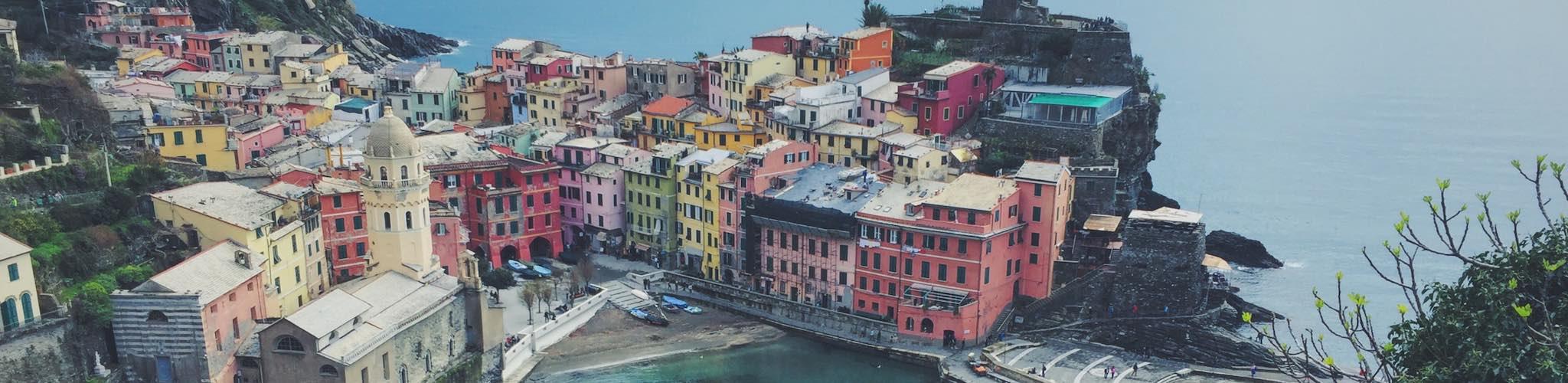
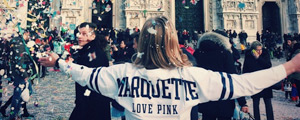
Nestled on the eastern slopes of Italy’s Appenine Mountains nearly 30 miles from the Adriatic Ocean, Cagli is a town of about 10,000 people with a history that stretches back to the sixth century B.C.
Built astride a river and around a mountain pass, Cagli became a crucial defensive post on the via Flaminia, a military route from Rome to the northern Adriatic. Several intact bridges and a tunnel remain near Cagli from the Roman era.
Pope Nicholas IV rebuilt the city after it burned to the ground in 1270 during the Guelf-Ghibbeline War, and Cagli remained part of the Papal States until the Italian Revolution of 1879. Unlike older towns, Cagli was rebuilt on the grid-style street layout typical of Renaissance town planning. It's centered on Piazza Matteoti with its cathedral and town hall and intermixed with upscale shops, restaurants, food stores and coffee bars with tables on the square. A weekly market day gives Cagli a unique blend of tradition and mondernity to the lively life around the main piazza.
Set in the mountains at an altitude of 1,000 feet, Cagli has long been a destination for hikers, skiers, and those who want to get away from the crowded cities and explore authentic Italian life and culture. Bicycle rentals allow tourists to explore the Via Flaminia and surrounding roads and trails. The city also features a major opera house, river swimming, waterfalls and the regional hospital.
This program combines classroom instruction and lab work with aspects of internship and practicum courses, including field work in an intercultural setting. Students work to produce a dynamic web documentary with faculty members serving as supervisors.
Students participating in the program will use classroom and lab experiences as a method for learning about the city's wonderful environment. Students will work in teams to find, shape, and tell stories about life and people in Cagli, turning what they discover into stories through writing, still photos, a video and a webpage. In addition to the course in Cagli, students participate in various excursions throughout Italy, including all-day trips to Assisi and to Florence concluding with an overnight tour in Rome. Students are encouraged to extend their stay in Rome or sign on to an additional tour in Italy.
The setting gives students a unique opportunity to access a foreign culture and acquire practical language skills rapidly using an immersion technique. The ability to assimilate quickly and hone in on another culture’s values are indispensable tools for anyone preparing for a career in a field where globalization and multiculturalism are increasingly important. At the micro level, students will learn how to read another culture on its own terms by living in a different culture and appreciating those differences. At the macro level, students will be ready to become facilitators in the intercultural dialogue that the modern world requires.
Visit the Cagli Program website to learn more about the program and view past projects.
Students live in apartments in Cagli. These apartments are fully furnished and contain full kitchens. Typically 3-4 students will share an apartment. The entire program will be divided among four apartment buildings.
Some meals will be provided by the program, including a few group dinners and meals on excursions. Students are responsible for hte majority of their meals and many choose to cook.
Eligibility
Minimum sophomore standing; 2.5 GPA
Language
Courses are taught in English
Orientation
A predeparture orientation will be held prior to leaving for Italy.
Courses Offered
The program comprises two 3-credit Marquette communication courses which can be taken for undergraduate or graduate credit. Both courses are part of the interdisciplinary minor in Italian. Grades will appear on the Marquette transcript and will factor into students' GPA.
COMM 4951, sec. 101 Intercultural Communication (3 credits)
This is an intercultural journalism course that includes the study of Italian and intercultural communication. It combines traditional lectures with assignments such as journaling and specific observational exercises. Students have counted this as a diverse cultures course in the University Core of Common Studies.
COMM 4951, sec 102 - Digital Storytelling (3 credits)
This course
is digital storytelling, which is a multimedia production course designed for students with no previous experience in the speciality and those majoring in mass media courses. Students have used this to fulfill electives in several different departments.
The course has two major components: a set of short instructional modules, and a set of open labs. The modules, which dominate the first two weeks, include lectures and field exercises in digital storytelling, story & script, photo/videography, interviewing, Final Cut Pro editing, and web design. The open labs, which dominate the third and fourth weeks, give students time to conduct and edit interviews, shoot and edit photos and video footage for their stories and to create their web pages with team mentors and other faculty members available for advice.
This is a short-term faculty-led summer program.
| Summer 2012 | |
| Program begins | May 21 |
| Program ends | June 21 |
A student visa is not required for this program, although all students must have a valid passport that extends three months past the ending date of the program.
Airfare is included in the cost of this program. If students wish to deviate from the scheduled itinerary by arriving early or staying after, they are responsible for covering the difference in airfare costs.
This program is a Marquette faculty-led program, so most financial aid generally applies. To learn more about how the program will affect your specific aid package, go to the Office of Student Financial Aid.