Founded in 1916, the Marquette
University Press, located in Milwaukee, Wisconsin, publishes
scholarly works in philosophy, theology, history, and other selected
humanities.
Click here to browse our book listing alphabetically by title and order directly from our distributor, BookMasters/Atlas Books
Marquette University Press announces the publication of Never a Slow Day, by Frank A. Aukofer, retired Washington bureau chief of The Milwaukee Journal and its successor, the Milwaukee Journal Sentinel. It is the first title in the new diederich studies in media and communication series, edited by Dr. Bonnie S. Brennen.
In the last half of the 20th Century, The Milwaukee Journal was regarded as one of the finest and most successful newspapers in the country. Never a Slow Day is the story of one Journal reporter, Aukofer, who started in the printing trade and spent his entire 40-year career as a reporter with the newspaper, for 10 years in Milwaukee and 30 years in the Washington bureau. 
He covered many of the historic events of the second half of the 20th century, including the civil rights movement and the aftermath of the assassination of the Rev. Martin Luther King Jr., the Persian Gulf War and two of the three impeachment proceedings in the nation's history against American presidents: Richard M. Nixon and William J. Clinton.
Aukofer also served as president of the National Press Club, and as president and chairman of the National Press Foundation in its formative early years. In retirement, he writes DriveWays, a weekly automobile review column distributed by Scripps Howard News Service.
The book is Aukofer’s account of his journalism adventures over the years, the incredible variety of events and stories he covered, and the exceptional people on which he reported. As he writes, it was interesting, sometimes dramatic, exciting or frightening, but always a learning experience, and why he never had a slow day.
Never a Slow Day - Adventures of a 20th Century Newspaper Reporter - Frank A. Aukofer
ISBN 978-0-87462-033-7 | 392 pages | 5.5 x 8.5 | 57 b&w photographs | Paperback | $37.00
TO ORDER: 1-800-247-6553 www.marquette.edu/mupress
When Swing Was the Thing: Personality Profiles of the Big Band Era, by John R. Tumpak. ISBN 13: 978-0-87462-024-5 & ISBN 10: 0-87462-024-4. Casebound. 329 pp. $35
The Big Band Era of 1935 to 1946 was the only time in America's history when jazz was the most popular form of music. Fifteen piece swinging dance bands swept the country in popularity. The music they played became an important part of America's cultural history and created a level of morale that helped pull us through the Great Depression and World War II. When Swing Was the Thing presents both an excellent introduction to the Era and new information for th
ose already familiar with it, providing detailed profiles of the Era's bandleaders, musicians, vocalists, arrangers, and contributors, many based on personal interviews. This book fully captures the nostalgic flavor of the Big Band Era through 114 vintage photographs and the story of the lives of the people who made it happen. John Tumpak is a jazz journalist who lives in Los Angeles and specializes in writing about the Big Band Era. His articles have been published in the United States, Canada, and England and archived in several historical societies, universities, and the Institute of Jazz Studies. Through the years Tumpak has developed personal associations with many of the bandleaders, musicians, and vocalists who participated in the Era. They are the subjects of his articles and provide valuable insights into the culture of the time. Tumpak also lectures on the Big Band Era at public presentations and on radio. He is a member of the Jazz Journalists Association, Los Angeles Jazz Institute, Los Angeles Jazz Society, and serves on the board of directors of the Big Band Academy of America.
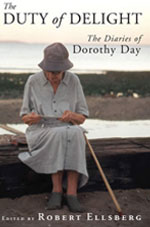
The Duty of Delight: The Diaries of Dorothy Day, edited by Robert Ellsberg
Dorothy Day, co-founder of the Catholic Worker movement, has been called “the most significant, interesting, and influential person in the history of American Catholicism.” For almost fifty years, through her tireless service of the poor and her courageous witness for peace, she offered an extraordinary example of the gospel in action. Now the publication of her diaries, previously sealed for twenty-five years after her death, offers a uniquely intimate portrait of her daily struggles and concerns. Beginning in 1934, soon after the founding of the Catholic Worker, and ending in 1980, just days before her death, these diaries reflect her response to the vast changes in America, the church, and the wider world. From the Depression-era labor struggles and her lonely pacifist witness during World War II, to the Cold War, Civil Rights, Vietnam, and the activism of the 1960s and 70s, Day was a witness to most of the great social movements of her time. And yet most of her life was spent in the everyday business of living: in the chores and demands of her extended Catholic Worker family; in her struggles to be more patient and charitable; in the discipline of prayer and worship that structured her days; and in her efforts to find God in all the t
asks and encounters of daily life. The record of this pilgrimage displays a rare balance between radicalism and tradition, action and contemplation, the transcendent and the everyday. Ultimately it challenges readers to imagine what it would be like to live as if the gospel were true.
Robert Ellsberg is the publisher of Orbis Books. For five years (1975-80) he was part of the Catholic Worker community in New York City, serving for two years as managing editor of The Catholic Worker newspaper. He has edited Dorothy Day: Selected Writings and Fritz Eichenberg: Works of Mercy, and has also co-edited A Penny a Copy: Readings from the The Catholic Worker. His own books include All Saints, The Saints’ Guide to Happiness, and Blessed Among All Women.
The Duty of Delight: The Diaries of Dorothy Day has won two First Place book awards from the Catholic Press Association:
First Place: Spirituality (hardcover): "These diaries, and the splendid work of the editor, are a gift to each of us. Instead of simply talking about justice, peace, the poor, the reader is invited to encounter the reality of each situation, event, and person with a mentor and a guide who can be trusted to shine the necessary light which illumines: Dorothy Day. The ordinariness of her life speaks to the extraordinary power of grace in action."
First Place: Biography: "Robert Ellsberg has done a magnificent job in editing this classic work. His is a great gift to the Catholic community, truly in a class by instead in this competition. He has arranged the complete diaries (1934-1980) of this saintly woman into 654 pages with a lovely introduction, exquisite editing, and frequent notes, plus index. Scholars and lay readers will benefit from this close-up and personal walk with one of the 20th century's great Catholic figures."
Milwaukee Television History: The Analog Years, by Dick Golembiewski. ISBN 978-0-87462-055-9. 510 pp. 470+ photographs. 8 ½ X 11. $47. Clothbound with dust jacket. Winner of the Milwaukee County Historical Society Gambrinus Prize for 2008.
With over 470 photographs this well researched and detailed history presented by Dick Golembiewski (a.k.a. “Dick Nitelinger,” host of “Folk City” (1984-1992) and “Milwaukee Talking,” (1985-1986) on WMSE radio) who began researching the city’s broadcasting history in 1996, expertly delivers the inside story of the city’s television stations since 1930.
From the first early tests using mechanical scanning methods, through the first successful digital television tests, the politics, conflicts, triumphs, and failures of Milwaukee’s television stations are described in fascinating detail.
Included are discussions of the many locally-produced shows — often done live— that once made up a large part of a station’s broadcast day and it is through these stories — some told here for the first time — and through the facts, anecdotes, and quotations from the on-air talent, engineers, and managers who conceived, constructed, and put the stations on the air, that the history of Milwaukee television comes alive again for the reader.
Milwaukee's Jesuit University: Marquette, 1881-1981, by Thomas J. Jablonsky. ISBN 978-087462080-1 438 pages. 130 illustrations. $40. Gold stamped cloth bound with color dust jacket. Notes. Index. Winner of the Milwaukee County Historical Society Gambrinus Prize for 2007.
See full book description via link below in our Series information area under: Other series and volumes Urban Life Series (UL)
Below on this page books are listed and described in detail by Series. Click on Author Index if you don't know the series.
Click here to contact the MU Press editorial
staff