

![]() |
WWW.MARQUETTE.EDU CAMPUS CONTACTS SITE INDEX |

The human side of economics
Who are you? A Social Security number, an American, a spouse, a parent, a child, a co-worker? Or all of these? What makes you you?
Economics professor Dr. John Davis thinks a lot about personal identity. In 2003, he published The Theory of the Individual in Economics. Now he’s working on a follow-up book that examines the individual in light of more recent changes in the economics field.
Those changes include the influence of other sciences. Psychologists were the first to discover that people don’t always act the way economists describe. “Psychologists tested such things as whether people behave strictly out of self-interest, and lo and behold, they found that they often don’t, destroying all the theories of economics,” says Davis, who also teaches at the University of Amsterdam in the Netherlands. “Many of these assumptions we’ve had for so long are now in jeopardy.”
That gives scholars like Davis a chance to re-examine the very foundations of the field. Davis is a prolific researcher who has written or edited 14 books, and the Association for Social Economics recently honored him with a lifetime achievement award. For 18 years, Davis was the editor of The Review of Social Economy, and now he is co-editor of the Journal of Economic Methodology.
He is used to going against the economic grain. While most economists believe that market values, such as prices and incomes, determine our social values, Davis and other social economists believe differently. They argue that beliefs about family, integrity, poverty, inequality and other social issues underlie our economic decisions.
Classic economic theory doesn’t hold up in the modern world, Davis says. “The standard view of the individual in economics explains the person in an asocial way,” he explains. “When we talk about personal preferences, they’re never things that might be created by advertising or by living in a community or by being the children of certain individuals.”
That doesn’t make a lot of sense to Davis. Then again, he doesn’t think like your average economist. He earned a doctorate in philosophy before earning one in economics, and that gives him a unique perspective in a field that has traditionally emphasized data and models.
The standard mathematical technique that economists use, optimization analysis, assumes that the subject always does what’s best for him or herself. Although psychology studies have shown that people don’t always act out of self-interest, that’s not Davis’ only problem with the theory. “The theory doesn’t distinguish whether the individual is a single person, a collection of people, an animal or a computer program trading on Wall Street. They can all be treated as ‘individuals’ and be explained as optimizing,” he says. “So it seems to be that the human person has become marginal in importance, and I think that is contrary to our view of the importance of the person.”
Davis takes a wider view of personal identity. While traditional economic theory presents humans as completely independent, Davis says our modern reality is more like a web, in which each of us is at the center of multiple social networks. Who we are is often defined by whom we’re with, be it family, colleagues, friends or fellow citizens.
“I think one of the fundamental problems in our modern society is what it means to have a personal identity,” Davis says. “People have many strong social identities, and as our society becomes more and more complicated, we seem to have more and more of these identities to manage. And because our many social identities are constantly changing, we are constantly in the position of having to re-conceive who we are. I think this social view is a much richer account of what a person is.”
Those social relationships, of course, also influence our economic decisions. For example, as parents we might make a decision based not on what’s best for ourselves, but what’s best for our children.
Davis hopes his scholarship will encourage other economists to see the individual in a new way, but he admits the standard view is well-entrenched.
“The most I can hope for,” he says, “is that people will ask themselves where does the rubber hit the road, where is the social, where is the life of ordinary people in economics?”
Armed with a new federal grant, Dr. Charles Wilkie heats up the field of fire retardancy.
Dr. Irene Guenther unravels the sinister relationship between fashion and fascism.
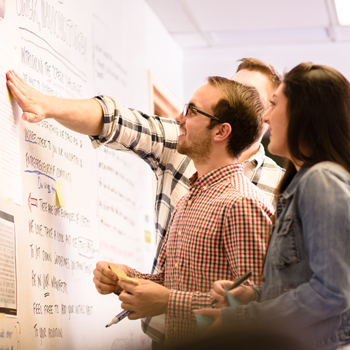
What does it mean to be an individual? Dr. John Davis examines the human side of economics.