
SEARCH RAYNOR
Looking for a book, article, or video? Visit the library search →
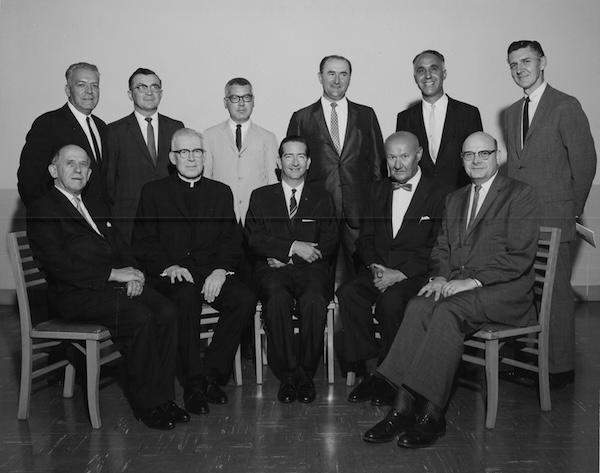
From 1949 to 1967, during the early years of the Cold War between the United States and the Soviet Union, Marquette’s Slavic Institute served as an academic refuge for Soviet Bloc scholars who fled repression and persecution in their home countries. The stories of these displaced scholars offer us a bridge between the historical struggles of the 20th century and the urgent global discourse of today.
Dr. Roman Smal-Stocki, 1893-1969, was a Ukrainian scholar, diplomat, and political figure who came up during some of Eastern Europe’s most turbulent decades. He served as the Slavic Institute's director 1949-1965.
Born in the Austro-Hungarian Empire in what is now Chrernivtsi, Ukraine, Smal-Stocki’s began his career as a diplomat during Ukraine’s brief time of independence. When Soviet forces consolidated control over Ukraine, Smal-Stocki fought for his nation’s recognition from abroad. He served in high-ranking positions in Ukraine’s government-in-exile and as a leader of the “Promethean” movement, a visionary group dedicated to liberating non-Russian nations from the grip of the Soviet Union. During World War II, he endured Gestapo house arrest in Prague for his Ukrainian nationalism—caught between Nazi occupation and Soviet domination.
After the war, Smal-Stocki emigrated to the U.S., and joined Marquette’s faculty as a professor of East European history. He became a Slavic studies pioneer and served as the Slavic Institute director from its inception in 1949 through 1965. He taught Marquette students about Ukrainian history, literature, and the broader Eastern European world, ensuring that Ukrainian culture and his people's struggle for self-determination would not be forgotten.
Dr. Bela Kovrig was a leading figure in Hungary’s Roman Catholic resistance during World War II. In 1946, under pressure by the communist secret police to become an informant, he fled across Europe in the trunk of an automobile. He later emigrated to the United States and joined Marquette as a sociology and political science professor.
Born in Croatia, Dr. Christopher Spalatin studied language at the University of Zagreb. As an emigré to the United States, he came to Marquette as a professor of foreign language and literature. He was celebrated for his scholarship and also his impact on students, for which he received the 1973 Excellence in Teaching Award.
Dr. Joseph V. Talacko, a native of Czechoslovakia, came to Marquette as a professor of mathematics. His expertise in the burgeoning field of statistics earned him the distinction of being named a Fellow of the American Statistical Association.