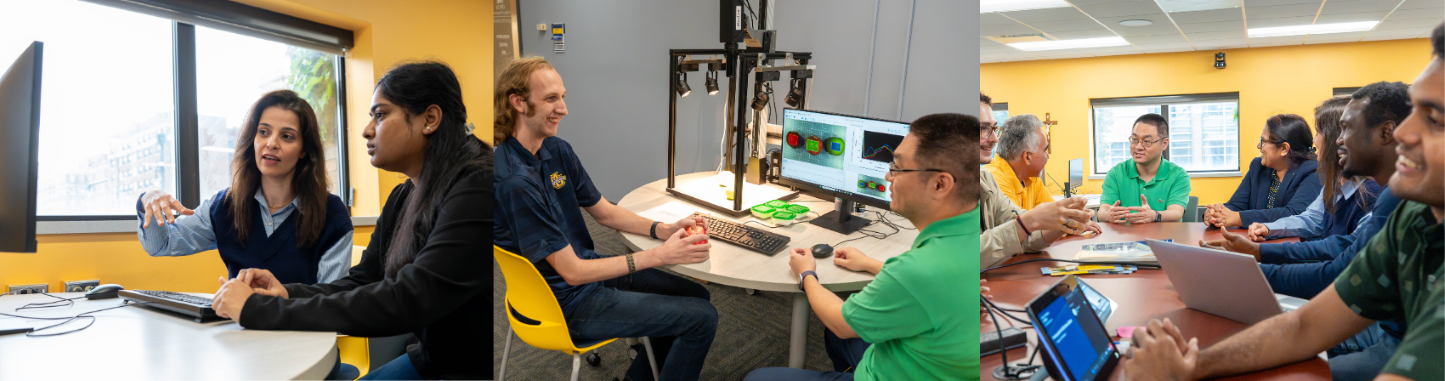
Marquette’s AI Discovery Hub is a collaborative learning space focused on the use of cutting-edge artificial intelligence in learning and research.
The hub connects human curiosity and problem-solving to emerging technologies in artificial intelligence and machine learning, exploring topics that include assessing AI bias and reliability, analyzing vast and unstructured MRI data, high dimensional image processing and analysis for enhancing environmental monitoring and more. Through open exploration, course-integrated visits and hands‑on demos, the AI Discovery Hub combines guided and self-directed learning experiences across AI subfields and the opportunity to develop new solutions based on individual interests.
Faculty and students in Marquette’s Opus College of Engineering guide visitors through a series of workstations centered on solving real problems for communities and improving how AI is responsibly used, designed and managed.
The space welcomes Marquette students, faculty and staff with an interest in how AI can better serve the common good. Industry and community partners are also invited to use the space to discover new skills and inspire current and future leaders of the field.
See our visitor hours for more details.
What you’ll find:
- Demonstrations and workstations across AI applications
- Guided and self‑directed learning opportunities
- Course visit support and ideation
- Project incubation, mentorship and peer collaboration
- Discussions and events on the ethical and responsible use and governance of AI
How to get involved:
- Marquette students: stop by at our scheduled hours or make an appointment to explore opportunities with our AI application stations. Students should also explore our events listings for more guided sessions and trainings.
- Faculty and staff: For opportunities to integrate artificial intelligence technology and demos into your courses or special student events, or to explore research collaborations, please contact Dr. Priya Deshpande (priya.deshpande@marquette.edu).
- Industry partners: To plan a visit or discover how you can collaborate with Marquette faculty and students, please contact matthew.curran@marquette.edu.
- K-12 educators and their students: plan a demo or visit with your high school students or teachers by emailing Shahd.Sawalhi@marquette.edu.
Current workstations:
Workstation 1: Assessing computer vision confidence and healthcare applications
Explore object detection and visual data processing in two sample projects related to measuring reliability of computer vision and how it can be used to support clinical care.
Project 1: Exploring image detection technology and the efforts to assess trust, confidence and data bias in image detection systems.
Project 2: Exploring how AI image detection and analysis can be applied to diabetic retinopathy screenings to support and scale human-centered clinical reviews.
Workstation 2: Spectral & hyperspectral imaging to extend beyond human vision
Investigate how a hyperspectral camera measures light wavelengths that go undetected by normal cameras and human vision, revealing additional information and differences between compared objects. As hyperspectral images capture hundreds of measurements at every pixel, AI is used to both sense and process vast datasets efficiently and intelligently, recognize patterns and provide insights in distinguishing materials. This technology supports applications in food quality, agriculture, medical diagnostics, manufacturing and environmental monitoring.
Workstation 3: Investigating Large Language Model (LLM) bias and reliability: healthcare and legal domains
Explore how LLM systems currently used in healthcare and legal contexts can be assessed for reliability and accuracy, as well as biases in their data collection and output.
Project 1: Compare real judicial opinions with AI-generated summaries to identify where LLM outputs differ from human analysis and when error occurs. This project explores the capabilities and limitations of LLMs.
Project 2: Dive into the ongoing analysis of LLM systems currently used in healthcare to understand how and why bias is measured. This project explores the broader push for ethical AI in healthcare and the research needed to determine how LLMs may be trusted in a healthcare context.
Workstation 4: AI and vast datasets in healthcare: aphasia care and brain/spinal cord MRIs
Explore how AI can be a solution for healthcare problems that depend on vast dataset analysis.
Project 1: Explore how LLMs, speech information and brain signal data can be used to support communication challenges related to aphasia and support future assistive tools for patients and caregivers.
Project 2: Explore how AI systems can help analyze and detect patterns from vast, messy datasets produced by brain and spinal cord MRIs. This project investigates where AI can accelerate insights from medical imaging that produces data too unstructured for human analysis.
Location, hours and appointments:
Location:
Haggerty Hall 268 (find the space on the West side of Haggerty Hall’s second floor)
Drop-in hours for introductory tours:
Monday – Thursday: 10:00 a.m. – 5:00 p.m.*
*The space will be closed on holidays, university breaks and campus closures
Recurring project demos:
Each week during the academic calendar, Marquette students, faculty and staff can visit recurring demo sessions focused on specific workstations and project examples.
Examing LLMs in the legal domain:
- Tuesdays, 10:00 a.m. - 12:00 p.m.
- Thursdays, 2:00 p.m. - 3:00 p.m.
Hyperspectral imaging:
- Fridays, 10 a.m. - 5:00 p.m.
Additional demo sessions coming soon.
Appointments:
To request a special appointment or discussion, please complete this form. For more in-depth collaboration discussions, please email Priya.Deshpande@marquette.edu.
Feedback and suggestions:
Faculty and students working in the AI Discovery Hub are seeking feedback and suggestions to help improve the AI Discovery Hub experience. Visitors are encouraged to complete this form to share feedback and suggestions.
Upcoming events:
Coming soon
FAQs:
Expand all | Collapse all
Who can use the AI Discovery Hub?
In Fall 2026, the AI Discovery Hub will primarily serve Marquette students, faculty and staff.
Industry and community partners are also encouraged to reach out with inquiries by emailing matthew.curran@marquette.edu. Additional programming for industry and community partners will be shared in 2027.
What do I do in the AI Discovery Hub?
Introductory tours of the space and explanations of projects are offered during drop-in hours. As visitors want to engage further in projects, faculty and students can share additional training sessions and opportunities to engage in ongoing projects.
Scheduled demos and events can also be found above on this webpage. These events provide guided opportunities to dive into a specific topic or technology.
Faculty and staff looking to incorporate the space and technology into courses or research can connect with faculty experts to design an experience or partnership to meet your needs.
As visitors gain familiarity and confidence in the workstations through events and demos, they may begin exploring new projects in the space with the support of faculty and students.
How does the AI Discovery Hub grapple with the growing challenges around AI in our society?
The AI Discovery Hub is designed with the understanding that AI is a technology with great potential and significant impact on our world’s future. The space is centered on connecting humans on this very topic, serving as a space for human collaboration, discussion and discovery of new knowledge.
Workstations in the AI Discovery Hub are selected based on opportunities to serve the greater good through careful development and human decision-making. Visitors are encouraged to ask questions, investigate potential benefits and consequences and develop their own perspectives on AI.
I already use AI. What does this space offer me?
The AI Discovery Hub invites visitors to dive deeper into how AI is applied to solve complex problems alongside human curiosity and direction. The project and application examples in the AI Discovery Hub go beyond daily use of AI for workflows and productivity. Instead, visitors will explore how technologists use cutting-edge hardware and software to solve problems that serve the greater good.
The space offers technology that is not widely accessible and goes beyond the AI use of most visitors. More importantly, the space serves as a hub of human connection to share ideas, insights and expertise.
I have a preference against using AI. What does this space offer me?
Differing opinions on AI’s role in society and how it is currently being used across industries and communities are important. Critical thinking about how and when AI is used in human work will only grow in importance as AI technology evolves and changes.
We invite visitors to learn more about the AI projects showcased in our current workstations. The workstations are selected as areas with greater potential to serve the common good and ability to spark new ideas among visitors. Visitors are not expected to commit to using any AI technology. Questions and perspectives on the benefits and consequences of a given AI application are encouraged.