
quick links
CONTACT
Thomas A. Silman
Operations Engineer
(414) 288-5423
PROBLEM WITH THIS WEBPAGE?
Report an accessibility problem
To report another problem, please contact coeweb@marquette.edu.
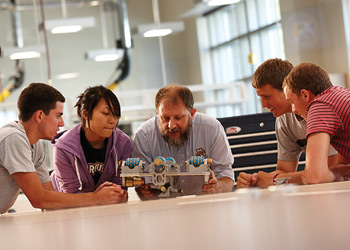
The Marquette Engineering program is design-focused and laboratory intensive. Many classroom and laboratory assignments are multidisciplinary and project-based. The Discovery Learning Laboratory provides a fully equipped, on-site machine shop for design and production of prototypes, test fixtures or complex objects. It is a place where students explore the practical aspects of engineering.
We have the following policies for operations of the Discovery Learning Laboratory Shop.
Dress code | Shop training | Lab space specific rules | project storage | DIY projects | Operations | Emergencies
All clothing fabrics shall be a natural fiber (such as cotton, wool or flax). No synthetics fibers are permitted, as these items can melt.
Appropriate clothing for shop activities:
Sandals, shorts, tank tops, hoods and holes in clothing are not permitted.
Many resources and access within the Discovery Learning Lab require completion of shop training. We expect all students to take an active role in learning how to operate each tool in a safe and effective manner. The staff of Discovery Learning Laboratory gives hands on instruction to all students on basic hazard awareness for each machine tool. Visit our training webpage to learn more and register.
DL128 (Student Design)
DL121 (Electronics lab)
DL125 (multi-discipline space):
DL113 (Large projects bay)
DL167 (Machine Shop)
Student project storage lockers are located in DL128 in Engineering Hall. Lockers are first come, first served. We reserve the right to open, examine and empty any locker.
Available lockers are unlocked. Pull the green lettered sheet from inside the locker and bring it to DLC Staff for checkout.
Storage rules:
If your project does not fit in the locker, please email dlc@marquette.edu. Include a summary of the project; duration of storage needed and project completion timeline; frequency of access needed; resources needed for the project (electric, exhaust, dust collection, glue, etc); volume, weight and hazards of project; faculty supervisor; project participant names.
The Discovery Learning Laboratory supports DIY projects that enrich student learning and confidence.
Students conducting DIY projects must (1) complete shop training, (2) write up a process sheet for the work to be shared with staff and (3) complete the project in a safe, appropriate manner.
The Discovery Learning Laboratory is used by other students, faculty and staff, so it is crucial to allow sufficient time in your timeline to complete your project.
Students are encouraged to discuss project ideas with our staff to explore options to advance the project and the appropriateness of the project for our space. Additional training and support cannot be guaranteed for DIY projects as staff must balance training, supervision and safety of users focused on academic projects.
Access Policy and Operations Policy

Privacy Policy Legal Disclaimer Non-Discrimination Policy Accessible Technology
© 2026 Marquette University