At 22, Marquette Grad Changing the Face of Journalism
 Two months after graduating from Marquette University in May 2025, Jolan Kruse is already changing the face of journalism. Now, the 22-year-old from Arlington Heights, Ill., is shooting for something even greater.
With a bachelor’s degree in journalism and social welfare and justice, Kruse started her first reporting job on July 7, at Buffalo’s Fire, an online publication based in Bismarck, N.D., that’s part of the Indigenous Media Freedom Alliance network. Her beat is covering missing and murdered Indigenous people in the Northern Plains.
Kruse’s two-year position is partly funded by Report for America, a national service program that puts emerging journalists into local newsrooms to report on under-covered issues and communities. Out of 1,300 applicants, Kruse was one of only 107 young journalists chosen this year.
In some ways, Kruse is starting her career in typical fashion. She works in a small, six-person newsroom and earns $47,500 a year. Unlike most newly minted journalism graduates, however, who may wait years to do the stories close to their hearts, Kruse is doing exactly what she wants: Providing a platform for neglected people and communities.
“It’s exciting to do this kind of workright out of college,” she said.
Indigenous people in the United States and Canada, especially women and girls, experience disproportionately high rates of disappearances and murders, a crisis rooted in poverty, inadequate law enforcement responses, and historical trauma.
Other media outlets have given spotty coverage to this issue, but Kruse’s position probably marks a first in U.S. journalism: A newsroom beat dedicated solely to missing and murdered Indigenous people (MMIP). She hopes to inspire other media outlets to do the same.
Kruse decided on a career in journalism during her senior year in high school. In choosing a college, the 2021 graduate of Prospect High School followed the lead of her older brother, Shane Kruse, who entered Marquette University in 2018 as a history major.
Jolan Kruse planned to study psychology but changed her major to journalism after taking a journalism class in her senior year in high school.
“I loved it,” she said. “I loved how journalists were constantly learning new things and meeting new people.”
Ron Smith, Milwaukee Neighborhood News Service executive director who taught Kruse as a freshman, recalled her insatiable curiosity about people and institutions. “That’s one thing you can’t teach,” he said.
At Marquette, Kruse found her calling: Using journalism as a vehicle for social justice. Kruse did volunteer work with homeless people, low-income children, and refugees, and used a Student Peacemaking Fellowship to travel to Cuba. During her junior year, she taught English to elementary students for four months in Cape Town, South Africa.
The experiences were an eye-opener for Kruse, who grew up in a middle-class family in suburban Chicago. Her mother teaches high school English, and her father owns a janitorial company.
“People have different resources and advantages, but we’re all human,” Kruse said. “Growing up in a middle-class suburb, you’re taught that people living in poverty are somehow different. They’re people to be avoided, mistrusted, or feared.”
At Marquette, Kruse got as much hands-on experience in journalism as possible. “You can’t learn journalism from a textbook,” she said.
Kruse served as a radio show host for The Wire, took on several reporting and editing assignments at the Marquette Tribune, and completed internships with WISN and the Milwaukee Journal Sentinel, where, in the summer of 2024, she pounded out more than 60 stories in 11 weeks.
“She brought a spark of extreme energy to the entire newsroom,” Journal Sentinel Senior Editor Thomas Koetting said. “She’s the only intern I remember in more than 25 years who never left the office without checking with an editor to see if there was anything else she could do.
“She had a strong sense of social justice and faith that journalism can make a difference,” he said. “It’s good for us as veteran journalists to be reminded why we got into this business.”
In her senior year, Kruse finished a nine-month student internship with the O’Brien Fellowship for PublicService Journalism, assisting Fellow Sylvia A. Harvey in investigating mass incarceration and unjust sentencing policies. Kruse wrote an article highlighting the injustice of state laws that impose mandatory life sentences on teenagers.
She told the story of James Lukes, a Mississippi prisoner who received a life sentence for a murder committed when he was 17. Now 73 and physically disabled, he maintains his innocence. Kruse’s investigation casts further doubt about the murder conviction, while depicting the cruelty of juvenile lifer laws.
“O’Brien showed me what it feels like to work on a long-term story that has the potential to create social change,” Kruse said.
“I was dipping my toes into the water. It reassured me that social justice reporting -- holding institutions accountable and advocating for people -- is what I wanted to do.”
After graduating, Kruse traveled around Europe for five weeks, then moved to Bismarck on July 3, four days before starting her new job.
Now, Kruse is aiming for something bigger than changing the face of journalism: Transforming the world by lifting the voices of the unheard, a mission that started at Marquette University. “I’ve got my foot in the door,” she said. “I know where I’m going.”
Pulitzer Prize-winner Jeffery Gerritt is the Director of the O'Brien Fellowship in Public Service Journalism.
(Photo Credit: Gabrielle Nelson)

 Outside Milwaukee’s acclaimed Harbor House Restaurant in May, the 2025–26 cohort of the O’Brien Fellowship in Public Service Journalism (From left: Graduate Assistant Nathan Lampres, Director Jeffery Gerritt, Fellow Eddie Allen, Graduate Assistant Bella Sciachitano, and Fellows Britta Lokting, Miles Moffeit, and Alison Dirr) gathered for a final meal to celebrate the achievements, friendships, and excellence of the previous nine months.
 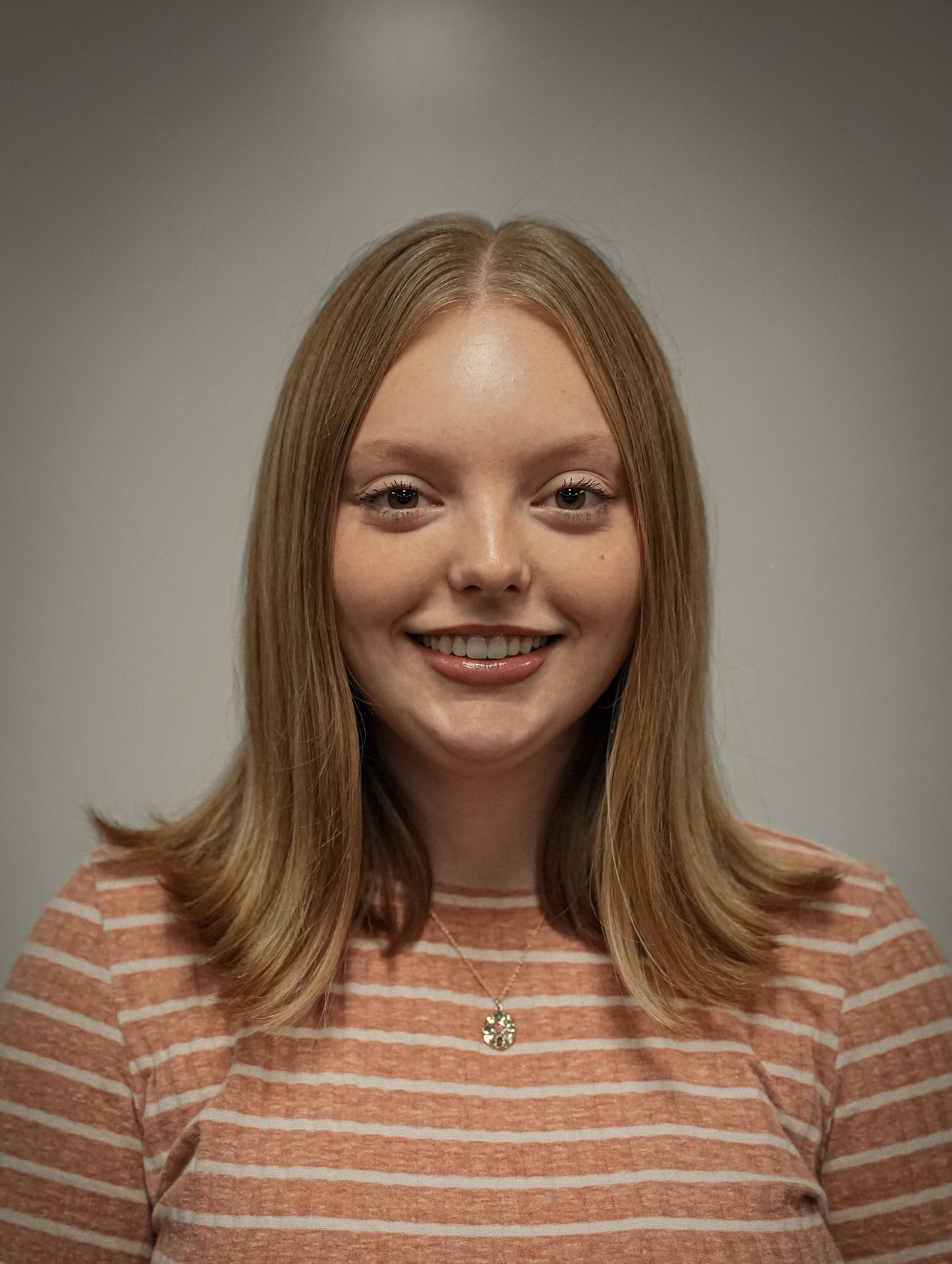 Mia Thurow, an O’Brien Fellowship student intern for 2025-26, is a third-year student majoring in journalism with a minor in Spanish and a concentration in communication leadership. She currently serves as Executive News Editor at the Marquette Wire and previously worked at the Milwaukee Journal Sentinel as a McBeath summer intern. She is passionate about investigative and human interest storytelling, and she hopes to help create a more representative media landscape where all voices are heard.
 In more than 35 years as a journalist, I never feared prisons, shooting galleries, gangsters, or power-obsessed politicians. Nor did combat zones in Ukraine or Gaza faze me. But a class of 20-year-olds staring at me with blank expressions, waiting to hear something intelligent or instructive, terrified me.